My mum Rene (Alice Irene Flitney née Harding) died in 1999. When my brother, sister and I went through her things we found an envelope full of old newspaper clippings and other bits and pieces. We looked through the papers and put the envelope away, but those yellowing pieces of paper keep whispering of half-forgotten times and places. Places like Butlers Cross, Stoke Mandeville, Aylesbury, West Wycombe, Little Kimble, Wendover, Ellesborough, Southcourt and Princes Risborough.

Showing posts with label Flitney Denis and Rene (Harding). Show all posts

Sunday, 14 September 2014

Perfectly suited

The very first post on this blog - A wreath of orange blossoms - raised an interesting question. I was asked if the pink and blue two-piece worn by mum (Rene Flitney) was an all over floral pattern, or a blue suit with a pink blouse. I’m not sure I can properly answer that as there are no photographs (as far as I know), but I thought it would be fun to try. 

Mum and dad were married in 1938 when, according to the University of Brighton, the desirable look for women was still slim, but more womanly and sophisticated than in the previous decade. This body shape was created through longer skirts cut on the bias and by an indented waistline and rounded bosom. This increased exposure of the body was due to sportswear’s influence on new styles, including the ‘halter-neck’ credited to the French couturier Madeleine Vionnet, which exposed arms and back.

According to the Victoria and Albert Museum;  Following the crash of 1929 and the Great Depression, new, more down-to-earth attitudes forced on the world offered great scope for a new simplicity. In Britain, fashion became more eclectic but also more feminine and graceful and, by 1930, the 'boyish' look had disappeared.  

Typical day wear for women consisted of a two-piece suit with sleek, fitted jacket and matching skirt or dress.  Floral designs dominated, but geometric forms were also much in evidence.

Rene Flitney aged 18
This is the only photograph I have of mum as a young woman. I'm guessing it was taken in 1935, around the time of her eighteenth birthday.

Rene Flitney 1938
This photo shows a more mature woman and the bashful look of a few years before has gone. I'm guessing it was taken around the time of the wedding in 1938.  

Considering the two photographs above, I think it fair to say a sleek fitted jacket with a matching skirt or dress in a printed fabric would have suited her very well.  


I rather like the dress and matching bolero on the right and according to one fashion critic speaking in May 1938 - boleros are being worn to refurbish or dress up last year’s ensemble. Mum, on the other hand, may well have preferred the smarter option on the left.

While looking around the Internet for inspiration I also came across this image that matches the pink and blue theme perfectly but would mum have worn it?  I'm pretty sure she would have hated the hat and bag, but the dress and jacket are quite pretty.


So what else might have influenced the bride to be in 1938?

Source Family life in Britain 1900-1950. ISBN 0316730343

When King George V died in January 1936, the romance between his eldest son, Edward, Prince of Wales, later to become Edward VIII, and the American divorcee Wallis Simpson, whom he had first met in June 1931, was well-known in Royal circles. When he succeeded to the throne, the young and popular King had to choose between his lover and the crown. The major political parties and the Church of England made it clear that marrying a divorcee was out of the question. The cabinet presented the young King with an ultimatum: give up Mrs. Simpson or renounce the crown. He would choose the latter.

For the 36-year-old Duchess of York, it was an earth-shattering event which propelled her from relative obscurity to become Queen Empress, reigning, with her husband, over 600 million subjects. The new King, George VI and his Queen were crowned at Westminster Abbey on 12 May 1937. Wallis and Edward married on the 3rd June 1937. Source BBC News


Queen Elizabeth (The Queen Mother) in 1938                    Wallis and Edward in 1937


Looking at the photographs of Queen Elizabeth and Wallis Simpson, I can’t help but wonder if mum would have chosen something far plainer than the floral affairs so far considered. Would any of these have suited?

Or this?


I don't think any of the above is quite right - but this, on the other hand, is! It’s a pink and blue, slim but womanly two-piece in the longer style, which would have looked good on Queen Elizabeth, Wallis Simpson and Rene Flitney.  Perfect…

If anyone happens to have a photograph of the actual going-away outfit, please share. I would love to compare my idea of the perfect suit to the one chosen by mum.  Comments are always welcome, so go on what do you think?  

Saturday, 9 August 2014

West Wycombe Park and the Hellfire Caves

Memory has a habit of playing tricks on me these days – did things happen the way I remember? Many of my memories are more than 60 years old. Would my sister and brother remember them in the same way? I have no idea, so all I can do is tell the stories as I recall them with a little help from cuttings, photographs and letters.


High Wycombe is another of those familiar sounding places that I don't really remember. This entry from my 'baby book' might give a clue;
Have you ever noticed when someone dies their handwriting doesn't change? Well, it wouldn't would it, but you know what I mean.

I don’t have any recollection of the shopping trips to High Wycombe, but I vividly remember conversations about West Wycombe Park, and the Hellfire caves. So a visit there felt like the next logical step.

West Wycombe Park on a beautiful sunny morning in July (2014)

West Wycombe Park is one of the most theatrical and Italianate of all English country houses and the Dashwood family home for over 300 years. Set in 45 acres of landscaped park, the house as we see it today is the creation of the 2nd baronet in the 18th century.

More from the National Trust website here


The grounds and house are frequently featured in screen adaptations of literary classics such as Cranford and Little Dorrit and more recently in the television series, Downton Abbey.

Polo in the grounds of West Wycombe Park 

After a lovely morning in the sunshine, it was on to the Hellfire caves and a very different experience. 

Located in West Wycombe the Hellfire Caves have a notorious history and are reputed to conceal many mysteries.  They are actually a man-made network of tunnels carved out of the chalk and flint of West Wycombe Hill commissioned by Sir Francis Dashwood. 
 Read More; The Hellfire Caves

The caves and the terrible deeds that supposedly went on there were discussed at great length when I was a little girl.  Mutterings of dark deeds, devil worship and debauchery were not intended for my small ears – but I heard, and I remembered!  So an opportunity to visit was not to be turned down.

Words on a plaque in the caves

My first impressions of the caves were a little disappointing. Too many people making too much noise, but as the saying goes ‘if you can’t beat them, join them’ and ghostly noises sound so much better when you are deep underground. As we got further into the tunnels, much of the chatter and squeals died away, and then it began to feel a little cold and distinctly creepy.  I was, however, unprepared for some of the images picked up by my camera.  I would hate to be alone down there, especially if the lights went out! 


The two photographs that follow have not been photoshopped or played around with in any way, they are just as they came out of the camera. They were taken in a particularly dark part of the caves, so I have no idea why they are so much brighter than all the rest. The camera settings were untouched during our visit. 

I make no claims about what they might show – I leave that to you. Suffice to say I find them very creepy!


Terry and I didn't notice a thing while in the caves, but my camera did. Had we seen this we would have left in a hurry!

The ghost hunting team from the TV programme Most Haunted carried out an over-night vigil within the caves during December 2003. They spent the night without lights and members of the team said the caves were the darkest place they had ever visited. During the night, they had many paranormal experiences, seeing orbs of light and hearing noises. Without prior knowledge of the mysterious Hellfire caves Derek Achora, the medium, felt the presence of a young girl dressed in white, and of females dressed in nuns' habits. “Ladies of the night” were said to have worn such attire to disguise themselves whilst entertaining members of the Hellfire Club in the caves.

Someone has an interesting sense of humour! Spooky toilet roll holder in the ladies loo at the Hellfire Caves.

Thank you for visiting. I would love to hear from you so please leave a comment.   

Tuesday, 5 August 2014

A Wreath of Orange Blossoms

Took place at Walton Parish Church, Aylesbury.

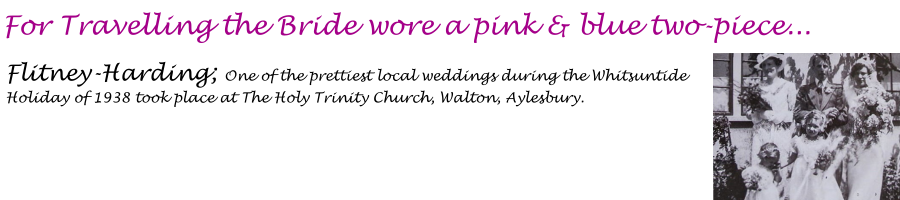
One of the prettiest of the local weddings during the Whitsuntide holiday was that which took place at Walton Parish Church (Holy Trinity, Walton, Aylesbury) on Saturday, when Mr Denis William Flitney, son of Mrs. and the late Mr. A. Flitney of 11, Council Houses, Butler’s Cross, was married to Miss Irene Florence Harding, daughter of Mr. and Mrs. J. Harding, of 37, Prebendal Avenue, Southcourt. A good number of friends had already assembled in the church when the bride, accompanied by her father arrived for the ceremony. She presented a charming appearance in her ankle-length white satin gown, veil and wreath of orange blossom, and carrying a bouquet of pink and white carnations.

There were two tiny bridesmaids, Patricia and Janet Harding, of Harrow, nieces of the bride, and they were chaperoned by Mrs. R. Harding, sister-in-law of the bride, who attended in the capacity of matron-of-honour.

The bridesmaids looked very pretty in their long dresses of blue satin, each wearing a wreath of blue and pink roses and forget-me-nots, whilst the matron-of-honour was attractively dressed in an ankle-length dress of white silk trimmed with blue and yellow floral designs, and wearing a white picture hat to match. The duties of best man were performed by Mr. Owen Flitney, the bridegroom’s brother.

The ceremony was impressively conducted by the Rev. Brian Hession, who, at its conclusion, addressed a few well-chosen words on counsel and advice to the bride and bridegroom, and wished them every happiness in the new life upon which they were entering.

Walton Parish Church June 1938. Photo taken at Prebendal Avenue, Southcourt

After the ceremony a reception was held at the bride’s home. Mrs. Harding, mother of the bride, whose health prevented her from attending the ceremony, was waiting to welcome Mr. and Mrs. Flitney on their return from the church. Later in the day they left for their cottage at Terrick, where the honeymoon was spent. For travelling the bride wore a pink and blue two-piece.

Denis and Rene 

Views of Holy Trinity Church, Walton - then and now

The Bucks Herald c1900

The same street - opposite direction

The Church unknown date


With a new porch and the original door no longer in use, July 2014


Interior Holy Trinity Church, Walton July 2014

I was unsure of the date of the wedding but a quick visit to BMD produced the following;

Surname First name(s) Spouse District Vol Page 

Marriages Jun 1938   

Harding Alice I F Flitney Aylesbury 3a3932 

I felt sure mum and dad were married in the spring so the date (June) came as something of a surprise. Whitsun, or Whit Sunday is the seventh Sunday after Easter (Pentecost), and this website confirmed Whit Monday 1938 fell on Monday 6th June. From that I assume they were married on Saturday the 4th June, but I don’t have the marriage certificate so that is just an assumption.


July 2014 plaque inside the church showing the Vicars of the Parish including the Rev. Brian Hession
(The ceremony was impressively conducted by the Rev. Brian Hession)

We hoped to visit the places where Denis and Rene lived before their marriage, Prebendal Avenue was easy to find, but we had no luck at all with No. 11 Council Houses, Butler’s Cross. The newspaper cutting also mentions a cottage in Terrick where they lived after the wedding, but once again, we drew a blank.
If anyone reading this has any information or pictures we would love to hear from you. 


37, Prebendal Avenue, where Rene lived in 1938. Photographs taken July 2014


A note about Walton; Walton is a hamlet in the parish of Aylesbury in Buckinghamshire. It sits north of the junction between two major turnpike roads, and was once the location of a toll gate and the toll keeper’s cottage. It has also, in its time, been the location of a foundlings hospital and a leper colony. The stone-built Holy Trinity Church in Walton opened in 1845 to provide a local place of worship for the farm labourers who lived in the hamlet, and canal workers from the newly built 1814 Aylesbury arm of the Grand Union canal. A hall was built in 1859 next door to the church to start what was to become Walton Holy Trinity National School (now Walton Hall) to support and educate local children. Walton Hall has always been both independent from and also supported by members of Holy Trinity and has been a focus of local community life from its beginnings in 1859. In the Second World War Walton was the landing site of the only bomb to be dropped on Aylesbury by enemy aircraft. The 15 pound bomb destroyed the medieval Walton Grange and severely damaged most of the other houses in Walton. [Wikipedia]


 Market Place, Aylesbury as Denis and Rene would have known it


and Market Place, Aylesbury now


1954 OS map of Aylesbury

That is probably quite enough for a first post, so I will close now. Thanks for calling in, your visit means a lot.

Related Posts Plugin for WordPress, Blogger...