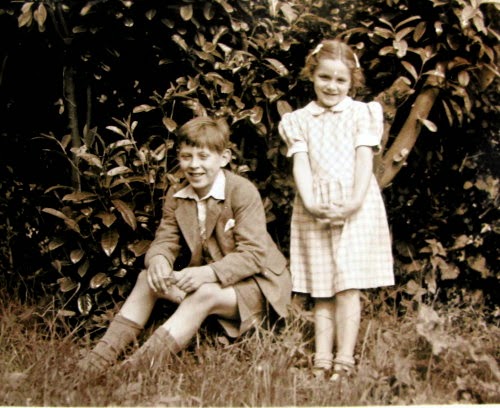
My mum Rene (Alice Irene Flitney née Harding) died in 1999. When my brother, sister and I went through her things we found an envelope full of old newspaper clippings and other bits and pieces. We looked through the papers and put the envelope away, but those yellowing pieces of paper keep whispering of half-forgotten times and places. Places like Butlers Cross, Stoke Mandeville, Aylesbury, West Wycombe, Little Kimble, Wendover, Ellesborough, Southcourt and Princes Risborough.

Showing posts with label Tony Flitney. Show all posts

Thursday, 26 March 2015

Farming at Ibstone, Buckinghamshire and Thame, Oxfordshire in the 1940s and 50s

This week’s Sepia Saturday prompt sent me rushing for the family albums. My dad and brother were both farm workers, and much of my childhood was spent riding around on tractors. I don’t claim to know anything about these machines because I was only about four when the photographs were taken. My brother Tony is ten years older than me, and I'm guessing he was about fourteen in the first picture.  

My brother hard at work on a Fordson Major tractor.


Me Barbara Fisher (nee Flitney) when we lived in Ibstone.


My dad is driving this odd-looking caterpillar/tractor type thing. I'm not sure who is on the Combine Harvester. It might be dad’s brother Owen (Flitney) or a German Prisoner of war.  My brother and sister both remember the POWs, who worked on the farm. I have only vague recollections of the stories my parents used to tell. I know they became particularly close to one of the prisoners and talked about him all the time, but sadly I can’t remember his name.

Even before the German surrender some of the POWs were put to work as agricultural labourers. After VE-Day, all prisoners were required to work. Most POWs were employed on farms, as Britain urgently needed a high level of food production, and there was a shortage of agricultural workers.

At first, it was usual for groups of about thirty men to be escorted by armed guards to the fields where they were to work. They were kept under close supervision at all times. However, following the German surrender, the British government allowed some prisoners to be billeted on the farms where they were employed under minimal supervision. Typically, one to four POWs would live at each farm, often taking their meals with the farmer and his family. In this way, close bonds were forged between the farmers and the German prisoners. Source Wikipedia 

Update December 2017 – the caterpillar is a Fowler FD3, and the harvester is a Grain Marshall 568 Combined Harvester. With thanks to my brother Tony Flitney. 

We were living on a farm at Ibstone in Buckinghamshire when the photographs were taken. My sister and I have vivid memories of trees being cut down in the woods around us.  The noise of tractors and heavy chains is something you don’t forget.  I looked online to see if I could find out what this machine is called and stumbled across several pictures of antique logging tractors that look very similar so maybe this is the one used for the logging. [Update December 2017 – my brother confirms this was the caterpillar used for logging and the trees being felled were large beech trees, which were taken to High Wycombe for use in the furniture trade. There is an interesting article about furniture making in Wycombe here]


The photographs of the Claas Combined Harvester that follow were taken on a farm near Thame in Oxfordshire, my dad is driving the tractor, and my brother Tony is up top. 


Fast forward thirty plus years and my brother is still hard at work.


In the first of these two photographs, he’s showing Sarah, Duchess of York the controls. The second picture shows Prince Andrew and Sarah standing with the digger.  These were taken during the very early stages of the building of Sunninghill Park in Berkshire destined to be the new home of the (then) happy couple.  


Fast forward another thirty years, my brother is retired. Andrew and Sarah are divorced, and I'm sharing photographs with friends from around the world, how times have changed. Now it’s time for you to plough a straight furrow over to Sepia Saturday to see what my fellow Sepians are reminiscing about.

This is my contribution to Sepia Saturday 272 : Tractors / Agriculture / Wheels


Wednesday, 29 October 2014

Guest Post; My Sister Remembers - Part Four

Memories of Susan Poulter nee Flitney; Sue is my older sister (although she looks younger!)
Previous instalments here, here and here 


Great excitement came to the village of Ibstone in 1953. It was the year of the Coronation of Elizabeth II which in Ibstone meant a sports day, decorated cycle competition and many other events. Tony and I entered the best decorated cycle competition and spent hours putting red, white and blue crepe paper around the spokes in the wheels and everywhere else we could add a bow or flag we did – but we did not win a prize. Most of the village turned up to watch the ceremony on our TV, and I remember mum was in her element making tea, handing round cakes etc.,

In the summer life would be really good (as long as mum and dad were talking), dad would take us all to Shiplake where we would paddle in the river and have picnics. Summer in my memory was always hot and sunny, apart from the thunderstorms, which I hated. I spent many hours in the woods making camps with my friends, swinging from ropes on trees and pretending I was in the circus. I always imagined that one day I would move to the other side of the valley, have a big house and horses, shame dreams get shattered!

    Rene Flitney (left) and Denis Flitney (right) in the river with Tony, Sue, Barbara & friends       

It was hard for mum and dad to keep up with all the demands for uniform, items for cooking classes, material for needlework classes, gym kit and so on at High Wycombe school and I would often be the one that didn't have all I needed. This led to other children being really nasty and the fact that my dad had an old car also meant I got a lot of stick. Homework would take me hours as I was so anxious all the time, so it was with some relief that I learnt my dad was looking for a new job and we would be leaving Ibstone. Mr. and Mrs. Andrews had decided to get rid of the Jersey cows, which were my dad’s pride and joy, and replace them with pigs which, although we had some when we lived at Twigside for our own consumption, he didn't like working with.

Mum was really upset as she had friends at Ibstone and a lovely modern detached bungalow but, dad being dad, did his own thing and got a job on a farm near Thame in Oxfordshire and moved us all in to a much older, inner terrace house. This was a real come down for mum who was most unhappy with it.  I was about twelve when we moved, and I think the farm was at Scotsgrove. Excuse me (Barbara) butting in here, I just want to confirm the farm is at Scotsgrove. Terry and I visited in July 2014.

The house at Scotsgrove in the 50s - could that be mum in the doorway?

The same house in 2014, the only noticeable difference is the size of the hedge!


There was a large carthorse called Captain  who I was allowed to ride and as horses were my great love I started to relax. I took myself off on long rides at the weekend with no tack other than a rope halter. There were lovely bridle ways around Thame so summer was a joy; I used to ride down a track which ran outside the grounds owned by Sir Lawrence Olivier (the English actor) and his beautiful wife Vivian Leigh. I always thought I might see them one day, but no such luck.

In the winter the meadows opposite our house would flood and then freeze so we would all go ice-skating whenever we could. My sister, Barbara, remembers going out in the meadow before the water froze, with a little boat belong to my brother Tony.

I do remember it Sue. I don’t know how old I was, but I hadn’t started school – so not very old. Tony had a sailing yacht, and I thought it would be fun to float it on the flood waters. I crossed a road in front of the house and then walked a fair way down a track to the fields. It wasn't long before the water was over the top of my wellies but it didn’t deter me.  I must have been playing in the water for at least a couple of hours when I heard shouting and looking up, saw mum, dad and several other people heading towards me through the floods. It’s probably one of the only times I ever saw dad looking really cross!  By the time they found me, half the people in the village (including the local bobby) were out searching. I remember dad scooping me up onto his shoulders and carrying me back home through the floods – quite an adventure but one I didn't repeat!

By this time, life was a little better for mum as Thame was not far away and there were more shops, and she could get out easily by catching a bus at the stop opposite the house. I went to Aylesbury Grammar School and found it was much nicer going to a mixed school. My dad had been a prefect there in his school days and some of the older teachers remembered him, so I was made to feel very welcome and put into his old “house". Sport became my first love. I was in the school hurdles team and did quite well. I also sang in the school choir and because I was more relaxed, my academic work started to improve.
Thame High Street and Town Hall, 1957


My Auntie Babs and Uncle Fred lived in Aylesbury. They were competition ballroom dancers before retirement and my Auntie was also a pianist. They said I could have dance or piano lessons and I choose the piano. I used to go to them after school one day a week and I think I loved the tea more than the lessons. My aunt always served up small cucumber sandwiches and little home-made cakes on beautiful china and I was very impressed. I had a piano at home (it had been left me by a different aunt when we lived at Ibstone) so I thought it would be lovely to be able to use it properly. Of course, I could not practice as much as I should because living in a terraced house it upset all the neighbours!


Unfortunately my time at Aylesbury School didn't last long as within a year my dad had fallen out with his employer and we were on the move again. I think he had numerous interviews, but the one we children remember best was one for a job on the Isle of Wight. The journey across was awful with a really bad storm; I remember sitting up on the deck where I felt safest and chatting to a farmer who was taking sheep over to the island. When we got there we went in dad's car to what seemed the centre of the island to this most beautiful farm. The farmer and his family seemed very nice and friendly. They had dogs, horses, a tennis court and swimming pool – all the things that were quite impressive to us youngsters. The house that went with the job was a really large very old farmhouse and mum hated it – said that it reminded her of Twigside, and she was not going back to “the dark ages”. We were very disappointed, as I think was dad. On the way back to the ferry we stopped and picked some lovely white flowers – well we had never seen wild garlic before - the car smelt awful for days!!

Sue and Barbara on The Isle of Wight 

To be continued….


Saturday, 27 September 2014

Ibstone, Bucks & Well Manor Farm, Hampshire.

Sepia Saturday provides bloggers with an opportunity to share their history through the medium of photographs.

Today’s theme is; Motorbikes, pillions, uniforms, couriers, turbans, tents and towels;


I've had a largely unsuccessful rummage through the family albums in the hunt for uniforms, couriers, turbans, tents and towels.  Motorbikes proved a little easier, so that will be my theme for this my first foray into Sepia Saturday territory.


What can I say about this photograph? Only my dear old dad would pose on a motorbike while wearing a suit, tie and not so flat - flat cap! I hadn't realised how odd the term ‘flat cap’ sounded until I typed it. According to Wikipedia, there are numerous other names for the same type of headwear, names like Paddy cap, longshoreman’s cap, scally cap, Wigens cap, duffer cap, bicycle cap, cheese-cutter and bunnet!  

Regardless of what it’s called dad never left home without one. Interviews, hospital appointments, days out, working on the farm, his cap went with him. His ritual on leaving the house was always the same. He would recite the words “spectacles, t-------- (word removed for the sake of decency), watch and wallet" while patting the appropriate points on his body.  Thinking back it would have made more sense to replace spectacles with cap, but then it wouldn't have rhymed! 


Dad doing his best Norman Wisdom impression, note the cap is firmly in place although this time worn backwards. Dad was a huge fan of Norman Wisdom the "little man" in the ill-fitting suit and cloth cap. He always watched the programmes on TV and knew many of the songs and gags off by heart.

  Mum played the piano a lot when we were kids. This was one of her favourite songs.


Now it’s the turn of my brother Tony to model the bike! I have no idea what was going on with the car. It's on blocks and covered by a tarpaulin (does that count as a tent?) so I presume it was a work in progress. It looks to me as though Tony has something (oil?) on his hands, so perhaps he was helping to do the car up. Tony if you should read this maybe you could let me know what you remember.


Tony looks to be in his early twenties here, so I'm guessing it was taken at the end of the 1950s.  One thing I've noticed while looking through the photos is the number of times my family have their pictures taken while standing in front of windows and/or drainpipes!  

I don’t think mum ever rode pillion, but later she did own and ride a moped.  This bike looks very similar to the one in the first photograph apart from the registration number, but then I know nothing about motorbikes so it’s probably nothing like it at all...
Mum, dad and Peggy a dog of many varieties. 


For more exploits on wheels and other exciting things, please visit Sepia Saturday

Monday, 8 September 2014

Guest Post; My Sister Remembers - Part Two

Memories of Susan Poulter nee Flitney; Sue is my older sister (although she looks younger!)
Previous instalment here

I remember going up to London with mum and Tony during the last few months of the Second World War. Mum’s family lived in Harrow on the Hill and during one visit there was an air raid and we all had to get under the dining room table, luckily no bombs came near.  I also remember going to a concert at the Royal Albert Hall, but we had to leave and go to an air-raid shelter.

Grandad Harding and Gladys Harding
Grandad Harding (mum's dad) and his second wife Gladys

My sister, Barbara Anne, was born when I was six years old - the result, according to mum, of dad drinking too much potato wine! Mum, who had been able to go out more as Tony and I were both at school, was very unhappy about having another baby and would only speak to dad through my brother or me. I think mum managed to make it clear to my sister all through her early and teen years that she was not really wanted. Dad used to spoil her rotten to compensate I think.

 Mum (Rene Flitney) with Barbara Anne - taken at Ibstone in 1948.

Dad had an office in the bungalow where he did the farm accounts for Mr. and Mrs. Andrews, he always seemed to be working in the evenings. This caused all sorts of problems for mum and dad, and I remember them arguing quite a lot. Dad would promise to take us out, but then the car would break down, and he would spend most of the day fixing it. This led to mum throwing tantrums (and saucepans) and very often threatening to commit suicide.  At some point during all of this my dad had an affair, and the marriage was really under threat. Working-class people didn’t get divorced in those days, and I remember granny Daisy coming and sorting it all out and my dad having to behave himself. He started taking mum to the village whist drive once a month and for a time, they seemed much happier together. He used to get good bonuses from Mrs. Andrews, and he also had a win on the football pools which enabled him to buy a newer car and a television. We were the first working-class family in the village to have TV and some of the Canadian troops who were based at Ibstone Common used to come around in the evenings to watch the ice hockey.

Denis Flitney, Tony Flitney, Sue Flitney, Rene Flitney nee Harding
Denis, Tony, Sue and Rene Flitney taken at The Bekonscot model village, Beaconsfield, Buckinghamshire.

Christmas was always special. Dad would take me to High Wycombe on Christmas Eve to get the presents. The sweet shops were magical places in those days.  We would buy sugar mice and Edinburgh rock. One Christmas I had a beautiful green velvet dress, but would really have preferred the blue one that was bought for my sister!

We seemed to have plenty of friends in the village; we always had our birthday parties in the garden. They were lovely little affairs, with sandwiches, jelly, blancmange and home-made birthday cake. We played pass the parcel, musical chairs and hide an’ seek – none of the paraphernalia that parents feel they need to provide today. Mind you, much as today, there would usually be a fall out between at least two of the guests. Presents were not expected in those days, and if you did get any, they would be very small – marbles or pencils were favourites. We didn’t have the toys that children have today; dad built us all bikes from odd bits. 

Sue, Barbara and birthday cake in the garden at Sonningfield Bungalow.

I remember Rebecca West asking what I would like for Christmas one year, I asked for a dolls pram.  She bought me one, which I expect was a jolly expensive one.  I am sure I would love it now, but at the time I was horrified as it was made of wood, about nine inches high and very brightly painted. I must have made quite a fuss because mum and dad managed to save up and buy me a “proper” pram for my Birthday, but I didn't forgive Rebecca West for many years!

Rebecca West (Mrs. Andrews) - further information from Wikipedia

When dad got a summer bonus, we would all have new clothes and go off to Cornwall for a caravan holiday.  I hated the journey down; we would set off at about 2am and travel all night. I remember on one occasion mum being really ill with asthma when we were in the middle of Bodmin Moor. In my memory, it was always very hot and one year we all got really badly sun burnt and had a few nights without sleep. Another year the weather was so good we all wanted to stay on longer. Dad phoned Rebecca West and she said that of course we must stay, and she sent some money to a bank in the nearby town. Dad didn't have to pay it back so she really must have held him in high regard.  

Susan Flitney Barbara Flitney Tony Flitney
The sun always seemed to shine! Susan, Barbara & Tony with Peggy.

We had a village shop in Ibstone and next door to the shop was a hall where we went to the “pictures” which were actually lantern shows. It was a real event and walking home by torch light was really exciting. 

To be continued....

Thursday, 21 August 2014

Guest Post; My Sister Remembers – Part One

I was born on the 20th May 1942 in the flat at Ibstone House, Ibstone, Nr High Wycombe, Buckinghamshire where my mum, Irene known as Rene, was the housekeeper to Rebecca West and her husband Henry Andrews and my dad, Dennis, was their farm manager.  Rebecca West (Mrs. Andrews) was one of my Godparents, and my full name is Susan Rebecca Irene Flitney.


My brother Tony was four years older than me, and I gather, got up to lots of mischief whilst living at Ibstone House. One year he chopped off the entire crop of tulip heads, and another picked all the flowers off the runner beans. I remember dad being very stern and taking his belt to Tony if he was naughty, and that was quite often. I remember parties at Ibstone House and being given home-made ice cream in the kitchen. Princess Margaret, other Royals and people in the literary world visited, but I can’t remember much about it other than mum “shushing” me if I became too noisy in the house. When I was at school we would perform our summer play at Ibstone House, and it was always a wonderful day with lovely food, and the sun always shone. Once I was asked to sing to Rebecca West’s guests, and in my very shaky voice sang ‘Summer time’. The wall around the house was a magnet for children, and I remember I once took some saddles and bridles from the tack room and put them on the wall so we could all play at ‘hunting’, that was another lecture for me and a belting for my brother.

After a while, we moved to Twig Side Farm (see map).


We had a prisoner of war staying with us and working on the farm. I can’t remember his name, but can remember being scared when I knew he was coming, but in fact, he was a really nice person and good fun to have around. The farm sat in the bottom of a valley with a steep track down. Loggers used to pull felled trees out of the woods using horses with chains; I remember being very scared the first time I heard them thinking it was ghosts in the woods. We had geese, pigs, sheep and chicken. I hated the geese because they used to chase me. I would always run and hide in the barn but on one occasion, they came in under the door, I remember screaming until my mum came to rescue me – I still hate geese!

Mum and I made butter with little wooden butter pats, one of my favourite jobs (and there were plenty!). She also made cheese and grew all our vegetables. I suppose it was the good life, but I am sure very hard work for everyone.  My dad would kill the pigs. He loved trotters (pig’s feet) for breakfast with wild mushrooms - it took me a long time to like pork.

Granny Daisy, Uncle Owen, Auntie Jean and Auntie Margaret used to visit in the summer, and we would have picnics in the fields. We were close to the Thames and in the middle of a most beautiful part of the Chilterns. I always thought Ibstone was a funny name, and it was not until I was older that I found out it is an old English name “Ibba Stan” meaning boundary stone of a man called Ibba. I have not been able to find out who Ibbas was, but he obviously staked his claim to a beautiful piece of England.   

Tony and Sue

 My brother Tony and I went to Ibstone Village School. We had a very steep hill to walk up, and it could get extremely muddy. We wore boots and then changed into slippers before going in to school.


Ibstone Church of England School - July 2014


 Mum became really ill with asthma, and the doctor said it was living in the valley, as it was always damp and misty. Mrs. Andrews decided to have a bungalow built for us in the village. This was really exciting! It was a wood faced detached bungalow built in Sonning Field, hence it was called Sonningfield Bungalow.  We had a garage and a utility room with a washing machine and a mangle. The scariest moment there was when we had a chimney fire and the fire spread to the loft. I have had a fear of fire ever since.

[I remember the night of the fire. I was very young at the time – perhaps three or four?  I was woken by the sound of a huge roar and a crackling, spitting kind of noise. In hindsight, I imagine the roar was the sound of the chimney catching fire, and the other noises must have been the wooden beams in the ceiling burning. My only other memory is of someone lifting me out of bed and then being outside watching sparks shooting out of the chimney.  I’m not sure about the last part. I don’t know if it’s something my mind has added in the intervening years but the sounds have stayed with me all this time and like Sue, I’m terrified of fire... Barbara]

Because Tony was older than me, he left Ibstone School first and went on to a school in Stokenchurch about four miles away. Naturally enough he made new friends and didn't want his sister tagging along any more. I really missed his company and decided I hated all boys! 

Sue in the front garden of Sonningfield Bungalow.  

July 2014; Sonningfield Bungalow replaced by a house named Sonningfield.   

To be continued....

Related Posts Plugin for WordPress, Blogger...