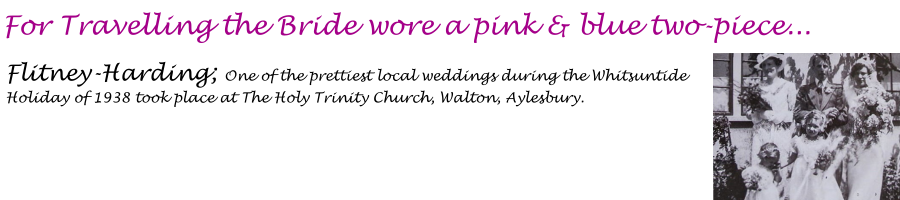
My mum Rene (Alice Irene Flitney née Harding) died in 1999. When my brother, sister and I went through her things we found an envelope full of old newspaper clippings and other bits and pieces. We looked through the papers and put the envelope away, but those yellowing pieces of paper keep whispering of half-forgotten times and places. Places like Butlers Cross, Stoke Mandeville, Aylesbury, West Wycombe, Little Kimble, Wendover, Ellesborough, Southcourt and Princes Risborough.

Showing posts with label Navy. Show all posts

Friday, 7 August 2015

HMS Scarborough - A Guest Post by John Flitney

See previous post here

A Whitby class / Type 12. Anti-Submarine Frigate

Photograph reproduced from The Scarborough Story, 1959 - 1961 Conway Bourke Ltd. Gosport, Hants 

After completing the gunnery training at Excellent I, along with the others from the training class who were joining Scarborough spent a few weeks in the Royal Naval Barracks at Portsmouth, which was then named HMS Victory. No not that Victory, I am not that old. That famous ship is in permanent dry dock within the naval dockyard, (and well worth a visit) the barracks was a ‘stone frigate’ outside the dockyard and now renamed HMS Nelson. During those weeks I was able to get long weekend leave, Friday pm to Monday 0700. A local coach company provided coaches for service personnel to most of the major cities in the country and I could get on the one to Manchester and be dropped off at Carfax in Oxford and Dad would come and pick me up from there about 7pm. Only snag was that the return coach got to Oxford at 0330 Monday morning, not Dad’s favourite time of day.

In the barracks we began to meet others who would become our shipmates for the next twenty-one months. On the 29th September,1959 the whole ship’s company assembled for the first time in the RNB drill shed and from there marched to South Slip Jetty in the dockyard and halted alongside our new home HMS Scarborough. After the commissioning ceremony we went aboard and got acquainted with our accommodation and layout of the ship. After all the dockyard officials and other senior officers and dignitaries had left “Clear lower deck!” was piped and we all mustered on the forecastle for a welcoming speech from the captain and to be told what we would be doing in the near future.  The Captain, Captain Josef Bartosik DSC RN, had served with the Polish navy from 1935 - 1945 and then transferred to the British navy and was now appointed Captain (F) 5th Frigate Squadron, that was us and HMS Tenby and HMS Torquay, HMS Salisbury would join us later.

After a few days we sailed for Portland, Dorset, for our ‘shake down’ where we all got used to our routines and got to know our specific duties and places for work, defence and action stations. Then we started the ‘work up’ exercises, all manner of evolutions in harbour and at sea to bring us all together into an efficient fighting unit. That achieved we were sent to Londonderry to take part in a N.A.T.O. exercise ‘Sharpsquall’. Appropriately named as it started for us with a ferocious gale in the Foyle. Scarborough had to secure to a buoy for the night. This entailed securing one anchor to the fo’c’sle deck, parting the anchor cable from it and then passing the chain forward through the ‘Bullring’, a circular fairlead, right at the bows and down to the buoy. That was the easy bit, the difficult part on this particular night, as the wind and water were so rough, was attaching the chain to the ring on the buoy. Not an easy task at best but one made really hard and dangerous for the ‘buoy jumper’ in those conditions. I was one of the sea-boat’s crew for the task and the coxswain had great trouble getting close to the violently moving buoy without damaging the craft and close enough for the man to jump on the thing. The job was eventually achieved and by the time the boat was hoisted back inboard the crew were cold, wet and exhausted. We were sent to the sickbay and to my surprise and pleasure I was given my first tot of rum, I was under age at the time but this was for medicinal reasons, the M. O. said so. During these first weeks aboard we had all been making new friends and I discovered that two other seamen lived in Oxfordshire not many miles from Murcott. Dusty owned a car and when we had weekends free we would share the fuel cost and travel in style in his Ford Eight. This all ended sadly late one Sunday night on the way back to Pompey (Portsmouth). On the old A34 between Newbury and Whitchurch, miles from a phone box as per usual in these instances, the engine blew up putting a con-rod through the side of the crankcase.

Old A34

Not the best place to breakdown so we started walking and discussing what sort of big posh car we would like to stop and pick the three of us up. There was not a lot of traffic at that late hour but eventually a car stopped, it was a stylish Jaguar, leather seats etc. The driver kindly agreed to take us, so we all got in the back much relieved at our good fortune. He dropped us off outside Aggie Western’s Sailors Rest not far from the dockyard main gate. As I recall conversation in the car had dwindle after our discovery of some scanty female underwear on the floor of the vehicle. I think perhaps we were rather enviously speculating what sort of weekend the driver might have had. The other one in the trio was Roger, he and I became ‘oppos’ and would have many ‘runs ashore’ together. He was a keen Gilbert and Sullivan opera fan and introduced me to those delights. Christmas was spent in Portsmouth with leave to both watches. So half the crew were home for Christmas and the others for New Year. During this time the dockyard carried out some maintenance. Then after a few more refresher exercises off Portland and another brief stay in Portsmouth the squadron sailed for the Far East on March 4th. On the way we did a S.E.A.T.O exercise and had a 48 hours visit to Gibraltar. This was my very first time on foreign soil. I spent my evening ashore taking in the sights of the town and I particularly remember the Flamenco dancers in the bars. Gorgeous girls in flowing dresses, very lively music to which they danced and sang with passion, while playing castanets. I didn't drink much but went back aboard intoxicated with the beauty of it all.

From The Scarborough Story, 1959 - 1961  

From Gibraltar we accompanied HMS Ark Royal to Malta, doing various excises with the Mediterranean Fleet on the way.

From The Scarborough Story, 1959 - 1961  

After a few days there we sailed east again to Suez and through the canal stopping next at Aden. My brother Richard was stationed there with the RAF but due to the civil hostilities ashore ships leave was restricted and alas we couldn’t get to meet.

From The Scarborough Story, 1959 - 1961  


Both from my collection

On from Aden to Colombo and then to Singapore arriving there on the 4th of April. Where we would stay for two weeks. Here I quote the words of the ship’s magazine about those weeks

“This gave us time to find the advantages and disadvantages of Terror canteen, Tiger, Sambawang, Tiger, Johore Bahru, Tiger, Singapore itself and Tiger. By the end of the period we were prepared to settle for Tiger.” 

HMS Terror was the naval base/dockyard and barracks situated on the north side of Singapore Island. Close by the dockyard gate was a canteen and bar, here I sampled my first Tiger beer, a brew I still like to this day. When it was really hot weather Tiger Tops was a favourite as it was very refreshing. It was Tiger shandy really. When the bar got really busy there could be as many as nine barmen working flat out. They worked in threes, one pulling the pints, two at a time. His mate had what looked like a water-pistol in each hand, they were actually to dispense the draft lemonade and he would quickly fire a shot in each glass. Payment was made to the third member of the team while this was going on and you were away with your drinks in no time at all. Another first for me was Monsoon drains, large concrete open channels to take the huge amounts of rainwater during the Monsoon period. They could be on average two feet wide and three feet deep as were the ones around the canteen. I mention them now because late one evening at the canteen a group of us saw something amazing. Tables and chairs were set out around the outside of the bar and the further ones were down a flight of steps and over a monsoon drain. The path to and from the bar was poorly lit and the steps quite dark. A group of five came off shore and wanted a last drink, to top off the ones they had already consumed. They nominated the least inebriated among them to get the beers. He trundle off to the bar like he was walking the deck of a ship in a force nine gale. The drinks were served in tapered pint glasses, we saw him next leaving the bar in much the same fashion as he had approached it, only now he had the five glasses clutched between his huge hands. No tray for this boy! On reaching the steps he paused for a moment before starting down, toward the bottom he lost his balance but quickly recovered by taking several steps to his right. This put him away from the bridge and on the edge of the drain, we all held our breath but he quite nonchalantly stepped over it and with succinct directions from his mates made it back to the table. As it happened said table was on sloping ground and even then he managed to put the drinks on it without losing any beer the whole journey. For which he got a big cheer, after taking a bow he sat down and promptly fell backwards out of his chair. For which he got an even louder cheer.

Up in the barracks were all the usual offices, parade ground etc plus a NAAFI shop. There were one or two other shops and a barbers shop with most of the staff being pretty Asian girls. A crafty ploy, I think, by the Commander to encourage ‘Jack’ to get his hair cut regularly. Sambawang was a village close by the dockyard and I first went there with my oppo Roger. He had spent some of his childhood in Penang, an island 440miles up the northwest coast of Malaysia so had some knowledge of the area and he introduced me to the culinary delights of the Orient. Starting with a Chicken Chowmein type dish, at a street stall in the village. There were promises of a proper curry too once we got into Singapore city itself and a visit to the delights of Boogis Street…but that’s another story….

From The Scarborough Story, 1959 - 1961  

to be continued


Wednesday, 10 June 2015

Further Training - A Guest Post by John Flitney

See previous post here

Si vis pacem, para bellum. (If you wish peace, prepare for war. ) The motto of the Royal Navy.

With that in mind the navy, in 1830, converted the third rate ship of the line HMS Excellent to a gunnery training ship and moored her at Whale Island in Portsmouth harbour. She was replaced by the second rate HMS Boyne in 1834 and finally HMS Queen Charlotte, first rate, in 1859. Both being renamed HMS Excellent. The guns were fired down a range on the island. The size of the island was increased with the spoils from the expanding dockyard. Eventually HMS Excellent became a ‘Stone Frigate’ a naval term for a shore establishment and continued as the navy’s principal Gunnery school.
(Third, second and first rate of a ship indicated its size and the number of guns it carried. Third rate had 48 - 60, seconds 90 - 98 and firsts had a hundred guns or more.)


Excellent’s reputation for discipline was well known and it was with a feeling of trepidation that I arrived there on the 20th May 1959. The place was immaculate and all personnel were correctly dressed at all times and moved smartly around the establishment. It was a case of having to as the shout “You ‘orrible man, report to me!” could come from anywhere. Except, and I found this out later, there was just one place on the entire island you were told to do the opposite. Between the main accommodation area and the parade ground was an area of grass and trees with a collection of flowering shrubs. Paths across this place took you through the shrubs and past a small menagerie hidden within. Here were housed several species of parrot and one of these was quite vocal. It was a large green job and should you foolishly enquire of it “Who’s a pretty boy then?” the reply you got very succinctly, just two words, told you how to depart the area. It was the only thing that drew any complaints from visitors to the island it was so rude. I just cannot think where it might have learnt such language and me such a delicate young lad too…………tut tut!!

Training continued but now was concentrated on guns large and small. The biggest I experienced was a 4.5in. twin turret, all enclosed and hydraulically operated. The shells and cartridge were separate and supplied to the turret by hoists from the magazine. These were then manually taken from their hoists and placed on the loading tray and then mechanically rammed into the breach. The faster you could do that the better the rate of fire. The Bofors 40mm (1.57in.) twin open mountings were loaded with clips of five rounds at a time and if you could keep the feed going each barrel was, in theory, capable of firing 120 rounds a minute. A short trip in a lorry would take us to Tipner rifle range where we were taught all about the hand held weapons, mainly the Browning .303 bolt action rifle, Lanchester submachine gun and the heavier Bren machine gun. After tuition, in classrooms, on cleaning and maintenance of the weapons, how to use the sights correctly and how to reload their magazines we would go out on the range and shoot at various targets at differing distances. Snap targets were the most fun as they would appear suddenly in different positions for just a few seconds so you had to spot them then aim and fire quickly. We also took turns in the butts marking the shots of other classes. This was done by lowering the target after the ‘all clear’ whistle, all the targets were coloured black and white so we would paste a contrasting colour square over the bullet holes and then raise the target again.


Also at Tipner we learnt basic fire fighting techniques. Fires of different substances were lit to simulate possible situations aboard ship and allowed to get well alight before we had to put them out using the correct method, such as foam for oil fires. On larger blazes we used two hoses, one to create a spray that acted as a heat shield the other to fight the fire. One incident I heard about involving Tipner was about security at night. I’m not sure of when exactly it happened but at the time paraffin was still a popular heating fuel. The oil company Esso had added a coloured dye to their brand of the fuel and were doing a serious advertising campaign for it. The security guard, each night at Tipner, mainly to protect the armoury there, was made up of part of the duty watch from Excellent. The Officer of the Watch would at some point in the night travel to Tipner to check all was well. On the particular night in question the duty officer was the Paymaster, the supply officer responsible for money obviously. He arrived at the gate at Tipner at about 2am and wanted entry. The man on duty there correctly asked to see the officers ID card. He hadn’t got it, and I imagine the conversation gradually got more heated. “I’m sorry sir but I cannot let you in without seeing your ID.!” “I am the Officer of the Watch and need to get in to sign the security log here, open up at once!” “No sir! I do not recognise you and I would still have to see your identification card even if I did. It’s the rules!” “But, but I’m S. O. Cash!” “ I couldn’t care less if you was Esso Blue you aint gettin in ere wivout your ID!!”

We also travelled to Fraser Gunnery range at Eastney in Portsmouth to fire the bigger guns. I remember using ‘breakup shot’ (centrifugal force caused the filling of the Bakelite shell case to break it apart shortly after it left the barrel) on the Bofors. What was used in the 4.5s I do not recall. I cannot imagine we lobbed large, albeit dummy shells, out toward the busy seaway of the Solent.

For the first time now I was doing ‘duty watches’ every fourth day which meant extra work in the evenings or weekends. This involved cleaning work around the establishment, sentry duty and security patrols during the night. Also fire fighting if necessary, as a first response before the civilian brigade arrived. When not dutywatch evenings were mostly free and we were now allowed ashore, though as Junior seamen we had to be back aboard by 2359. Along Commercial road was a small cinema that screened nothing but cartoons in an hour and a half programme with two programme changes a week. I was a regular there twice a week. Also I spent a lot of time racing the dodgem type cars on a delightful figure eight track at Southsea funfair. There were the routine weekly mess inspections and kit inspections but they were less frequent now. There was also the inevitable parade ground. (I would have loved to use one of Uncle George’s fabled Oxometers here just to measure the amount of ‘bull’ applied.) So even more marching and rifle drill. We learnt even more complicated ceremonial drills such as firing squad at funerals, reversing arms as at street lining or mourners at state funerals. We simulated being an armed landing party and the formations required for that and how to defend ourselves should we have to form an anti-riot squad ashore.

Shortly before we finished our course at Whale Island we were issued with our tropical kit. This was a pair of white square rig suits, white shorts, blue shorts, knee length blue socks and a pair of brown leather sandals and white canvas shoes plus a white canvas kit bag to stow it in. This gave a clue that our next posting, known as a draft chit, could involve travel to warmer climes perhaps. Not long after the completion of the training our draft chits arrived. Myself and a small group of the other members of the class were to join HMS Scarborough, recommissioning on 28th September 1959 in Portsmouth after a major refit.


To be continued...............
Related Posts Plugin for WordPress, Blogger...