My mum Rene (Alice Irene Flitney née Harding) died in 1999. When my brother, sister and I went through her things we found an envelope full of old newspaper clippings and other bits and pieces. We looked through the papers and put the envelope away, but those yellowing pieces of paper keep whispering of half-forgotten times and places. Places like Butlers Cross, Stoke Mandeville, Aylesbury, West Wycombe, Little Kimble, Wendover, Ellesborough, Southcourt and Princes Risborough.

Showing posts with label Genealogy. Show all posts

Wednesday, 22 April 2015

Memories from an envelope

I was already putting this post together when I noticed this week's Sepia Saturday prompt - Aha thought I – two birds with one stone!  The two birds in question are my sister Sue and I (forgive the pun). There are no babies in the post even though we have five between us, but I hope two weddings will make up for that. The post contains an open letter to my sister; please feel free to read it. I have no secrets from you!


My mum (Rene Flitney) kept an envelope full of newspaper clippings, greetings cards and other bits and pieces. This is the second in a series of posts about items from that envelope. If you wish, you can read the first part here.   

It was no surprise to find a newspaper cutting from our wedding tucked inside the envelope, but we were surprised to find a wedding invitation. Those invites meant a lot to us back in 1970, but we didn't think to put one in our keepsake box. 

Terry and I agonised over the choice of design for weeks. Actually, I don't think Terry could have cared less, but he did his best to pretend he did!  In the end, we settled on a 'stained-glass window' effect. 


I have no idea why we chose the ones with a green background as our wedding was all white and pink! Perhaps colour themed weddings weren't so important then.

A Honeymoon in Austria 

A honeymoon in Austria and Switzerland followed the wedding at Odiham Parish Church of Miss Barbara Ann (Tut! my name is Anne) Flitney, daughter of Mr. and Mrs. D. W. Flitney, of Well Manor Farm, Long Sutton, and Mr. Terence Fisher, son of Mr. and Mrs. F. Fisher, of Blunden close, Basingstoke. The service was conducted by Rev. Philip Tidmarsh. 

Given away by her father, the bride wore a full-length dress of white nylon voile. It was high necked and the neck, bodice and cuffs were trimmed with pink lace. Her shoulder length veil was held in place by a band of white roses and she carried a bouquet of white lilies of the valley and pink rosebuds.

Attendants were the bride's sister Mrs. Susan Wood (Matron of Honour), and bride's nieces Paula Wood and Michelle Flitney. Mrs Wood wore a full length, pink dress with bell sleeves, trimmed with rosebuds. She wore a pink rose in her hair and carried a bouquet of pink and white carnations. Paula and Michelle also wore full length, pink dresses with long sleeves trimmed with white lace. They wore bands of tiny pink rosebuds and carried pink rosebuds and white stephanotis.
~~~

This is probably a good time to offer an apology to my sister!  Sue had no desire to be called a ‘matron of honour’ and even less desire to be dressed head to toe in pink!  She favoured a pretty green dress, thinking it would be better suited to her age and marital status. But I stamped and fumed and insisted on the pink.  Sorry Sue. Mind you, I still think you looked lovely in pink!


Our wedding day the 27th June, 1970. All Saints Parish Church, Odiham.
My sister Sue looking pretty in pink.  Me trying not to look at the camera! Terry on my left, David Jones (best man) on the right and Sue's daughter Paula in front. 


My brother Tony is holding the second little bridesmaid (right of picture third row back). Michelle hated the camera and refused to have her picture taken. 


3rd June, 1961 this time I'm the bridesmaid and my sister is the bride.  
From the left; Mr. & Mrs Wood, Mike Wood, Bob Wood (the groom), Sue, me, mum, dad and Marion in front.

Dear Sue, I was so excited when you asked me to be your bridesmaid. I loved my lilac dress, white gloves, socks and sandals.  I felt like a princess but looking back at the photos I can see I didn't look remotely like one. The little bridesmaid, on the other hand, looked adorable.

Did you know mum made me wear the entire ensemble, including the socks, to the end of year school party? Loud laughter and shouts of “she’s come as a bridesmaid” greeted my arrival. I was thirteen – can you imagine my shame? I spent the entire evening hiding in the loo, while my friends paraded around in mini skirts and white high-heeled boots!

So I guess that makes us even?

This is my contribution to Sepia Saturday 276: The Newlyweds and their baby

See who else is getting wed at  Sepia Saturday


Thursday, 6 November 2014

Alice Laura Harding née Wesley 1893 - 1939

Most of the stories on this blog have been about the Flitney/Stopps side of the family, but it’s now time to redress the balance a little.

A summer picnic; Left to right me (Barbara), Auntie Gladys, Sue, Rene Flitney née Harding and Thomas Harding.

By the time I got to know my maternal grandfather Thomas Henry Harding his first wife Alice (my grandmother) had died, and he was married to my Auntie Gladys. I just accepted that Gladys was my 'auntie' and that my ‘real’ grandmother was dead. I'm kicking myself for not asking any questions when I had the chance.  I know mum was often sad when she talked about her own mother, but I have no idea how she felt about Gladys. They always seemed to get on OK more than that I don’t know. Gladys is a complete mystery – I have nothing to go on. I will have to start by looking for a marriage certificate but for now I want to think about my Grandmother Alice Laura Harding née Wesley.  

Alice was born in Aylesbury, Buckinghamshire on the 26th December, 1893 the daughter of John (**a gas stoker) and Mary Wesley née Simmonds.

A team of gas stokers hard at work via

**At this time just about every town in the land had a gasworks. Gas lighting was common in most houses, and gas lamps were used to illuminate the streets. Industry too was dependent on gas, to fuel the engines that powered the factories. For most people a reliable gas supply was just a normal part of life, and something they took for granted. Very few knew or cared how coal-gas was made, and fewer wondered what it would be like to be a labourer in a gas-works. William James Thorne (1857 – 1946), British trade unionist, activist and one of the first Labour members of Parliament described it thus “The retort houses are exceedingly hot, for both behind and in front of the stoker are the burning eyes of the furnaces; amidst the roaring of the heat-hungry retorts a breeze as of hell fans me.” via

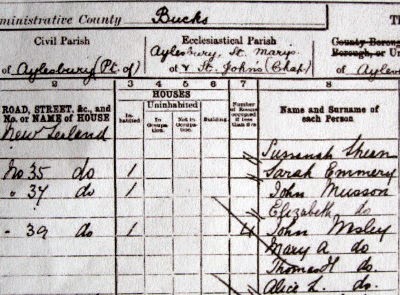
By 1901, Alice with her mother, father and older brother Thomas were living at 39, New Zealand, Aylesbury. I felt sure the address taken from the 1901 census must be a mistake, but it turns out New Zealand is a hamlet in the parish of Aylesbury. Apparently, the name comes from a breed of cattle that was farmed there. (Wikipedia)  

1901 census showing the family living at No. 39, New Zealand, Aylesbury.

When Alice and Thomas married in 1908, Alice’s family were living at Willow Road, Aylesbury and that was where Alice and Thomas started their married life. I'm assuming money must have been very tight for the family. Thomas was employed as a general labourer and his father in law was still working at the gas works.

My maternal grandmother Alice Laura Harding née Wesley

Alice and Thomas went on to have five children born between 1911 and 1917. Their youngest Alice Irene Florence (known as Rene to her friends and Dinks to her brothers), was born in 1917. By this time the family had moved once more and were living at Prebendal Avenue, Southcourt.

Thomas Harding back row far left. Alice & Rene front row second & third left. I assume the chaps in the back row must be their sons so perhaps the women are wives or girlfriends. 
With thanks to Sue Poulter for the photograph.

Money continued to be an issue for Alice and Thomas as recalled by Rene in this hand-written note from November 1994.

I often sit alone and think of my childhood. We were so poor and I always longed for Saturdays when my Uncle Peter came to visit – he was always worse for drink and would get to us after the pubs closed. My mother always cooked him a lunch. Her name was Alice and Uncle Peter would arrive, sit down by the fire and start crying saying, “don’t be cross with me Ally"  he would say it over and over it always worried me, so he would give me a penny and tell me to buy something nice. I would rush up town and buy a balloon and play with it until it popped, then I had to wait for the next Saturday.


Alice - (on right of  photograph)


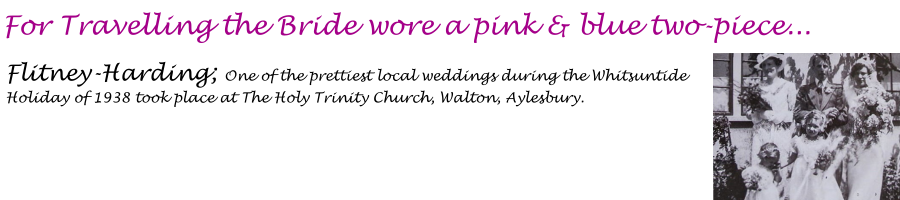
Alice was in poor health throughout most of her life and when her daughter Rene got married in 1938, she was too ill to attend the wedding.  

Just seven months later the newspapers were reporting her death;

Mrs. A. L. Harding; After a long illness patiently borne, Mrs. Alice Laura Harding, of 37 Prebendal Avenue, Southcourt, Aylesbury, died last Wednesday week (25th January 1939). Mrs. Harding, who was 46 years of age, was the wife of Mr.T.H. Harding. She was a native of Aylesbury, the daughter of the late Mr. and Mrs. John Wesley, formerly of Maldon Terrace. She had been in ill health for some time, and had twice been in the Royal Bucks Hospital, but her cheery disposition had never failed her. Four sons, well known in local football circles, and a daughter are left with Mr. Harding to mourn their loss. 


Alice was just 46 years old when she died. 


her husband (my maternal grandfather) Thomas Henry Harding

and their daughter Rene (my mother) looking remarkably like her own mother
Alice Irene (Rene) Flitney née Harding with Peggy.

This poem was found in Rene's diary. I assume she must have copied it from somewhere;

Memories are the pictures that an artist cannot paint. 
They’re secret, and they’re private. Some are sharp, and some are faint.
Memories that bring laughter, some that will bring tears,
Happenings of yesterday, or of those bygone years.
Memories of my childhood, of the games I used to play.
Memories of the good old days, that seem so far away.
I sit and reminisce, in the silence of my room,
Painting pictures of my memories and a love that died too soon.


Please write down your memories and pass them on to your children. They may not want to read them today, but one day they will.  

Wednesday, 29 October 2014

Guest Post; My Sister Remembers - Part Four

Memories of Susan Poulter nee Flitney; Sue is my older sister (although she looks younger!)
Previous instalments here, here and here 


Great excitement came to the village of Ibstone in 1953. It was the year of the Coronation of Elizabeth II which in Ibstone meant a sports day, decorated cycle competition and many other events. Tony and I entered the best decorated cycle competition and spent hours putting red, white and blue crepe paper around the spokes in the wheels and everywhere else we could add a bow or flag we did – but we did not win a prize. Most of the village turned up to watch the ceremony on our TV, and I remember mum was in her element making tea, handing round cakes etc.,

In the summer life would be really good (as long as mum and dad were talking), dad would take us all to Shiplake where we would paddle in the river and have picnics. Summer in my memory was always hot and sunny, apart from the thunderstorms, which I hated. I spent many hours in the woods making camps with my friends, swinging from ropes on trees and pretending I was in the circus. I always imagined that one day I would move to the other side of the valley, have a big house and horses, shame dreams get shattered!

    Rene Flitney (left) and Denis Flitney (right) in the river with Tony, Sue, Barbara & friends       

It was hard for mum and dad to keep up with all the demands for uniform, items for cooking classes, material for needlework classes, gym kit and so on at High Wycombe school and I would often be the one that didn't have all I needed. This led to other children being really nasty and the fact that my dad had an old car also meant I got a lot of stick. Homework would take me hours as I was so anxious all the time, so it was with some relief that I learnt my dad was looking for a new job and we would be leaving Ibstone. Mr. and Mrs. Andrews had decided to get rid of the Jersey cows, which were my dad’s pride and joy, and replace them with pigs which, although we had some when we lived at Twigside for our own consumption, he didn't like working with.

Mum was really upset as she had friends at Ibstone and a lovely modern detached bungalow but, dad being dad, did his own thing and got a job on a farm near Thame in Oxfordshire and moved us all in to a much older, inner terrace house. This was a real come down for mum who was most unhappy with it.  I was about twelve when we moved, and I think the farm was at Scotsgrove. Excuse me (Barbara) butting in here, I just want to confirm the farm is at Scotsgrove. Terry and I visited in July 2014.

The house at Scotsgrove in the 50s - could that be mum in the doorway?

The same house in 2014, the only noticeable difference is the size of the hedge!


There was a large carthorse called Captain  who I was allowed to ride and as horses were my great love I started to relax. I took myself off on long rides at the weekend with no tack other than a rope halter. There were lovely bridle ways around Thame so summer was a joy; I used to ride down a track which ran outside the grounds owned by Sir Lawrence Olivier (the English actor) and his beautiful wife Vivian Leigh. I always thought I might see them one day, but no such luck.

In the winter the meadows opposite our house would flood and then freeze so we would all go ice-skating whenever we could. My sister, Barbara, remembers going out in the meadow before the water froze, with a little boat belong to my brother Tony.

I do remember it Sue. I don’t know how old I was, but I hadn’t started school – so not very old. Tony had a sailing yacht, and I thought it would be fun to float it on the flood waters. I crossed a road in front of the house and then walked a fair way down a track to the fields. It wasn't long before the water was over the top of my wellies but it didn’t deter me.  I must have been playing in the water for at least a couple of hours when I heard shouting and looking up, saw mum, dad and several other people heading towards me through the floods. It’s probably one of the only times I ever saw dad looking really cross!  By the time they found me, half the people in the village (including the local bobby) were out searching. I remember dad scooping me up onto his shoulders and carrying me back home through the floods – quite an adventure but one I didn't repeat!

By this time, life was a little better for mum as Thame was not far away and there were more shops, and she could get out easily by catching a bus at the stop opposite the house. I went to Aylesbury Grammar School and found it was much nicer going to a mixed school. My dad had been a prefect there in his school days and some of the older teachers remembered him, so I was made to feel very welcome and put into his old “house". Sport became my first love. I was in the school hurdles team and did quite well. I also sang in the school choir and because I was more relaxed, my academic work started to improve.
Thame High Street and Town Hall, 1957


My Auntie Babs and Uncle Fred lived in Aylesbury. They were competition ballroom dancers before retirement and my Auntie was also a pianist. They said I could have dance or piano lessons and I choose the piano. I used to go to them after school one day a week and I think I loved the tea more than the lessons. My aunt always served up small cucumber sandwiches and little home-made cakes on beautiful china and I was very impressed. I had a piano at home (it had been left me by a different aunt when we lived at Ibstone) so I thought it would be lovely to be able to use it properly. Of course, I could not practice as much as I should because living in a terraced house it upset all the neighbours!


Unfortunately my time at Aylesbury School didn't last long as within a year my dad had fallen out with his employer and we were on the move again. I think he had numerous interviews, but the one we children remember best was one for a job on the Isle of Wight. The journey across was awful with a really bad storm; I remember sitting up on the deck where I felt safest and chatting to a farmer who was taking sheep over to the island. When we got there we went in dad's car to what seemed the centre of the island to this most beautiful farm. The farmer and his family seemed very nice and friendly. They had dogs, horses, a tennis court and swimming pool – all the things that were quite impressive to us youngsters. The house that went with the job was a really large very old farmhouse and mum hated it – said that it reminded her of Twigside, and she was not going back to “the dark ages”. We were very disappointed, as I think was dad. On the way back to the ferry we stopped and picked some lovely white flowers – well we had never seen wild garlic before - the car smelt awful for days!!

Sue and Barbara on The Isle of Wight 

To be continued….


Wednesday, 8 October 2014

High Holborn Farm - then and now.

High Holborn Farm is another of those names from the past; 


My dad (Denis William Flitney) and my grandmother (Daisy Clara Flitney nee Stopps) must have discussed the farm, but I don’t remember any of the stories. I just have a strong recollection of the name and the fact that it was close to a place called Little Kimble in Buckinghamshire. Terry and I visited Little Kimble several times during our holiday but the farm always eluded us. Then on the final day, we decided to have one last try. We drove around the area a few times and were on the point of giving up when we happened upon an elderly lady out for a walk.   A quick question to her and we were on our way. I can’t tell you how exciting it was to see the name. It’s somewhere I've ‘known’ for more than 60 years without knowing it at all.

William and Mary Stopps (via ancestry.com)

Research shows that my great grandfather William Benjamin Stopps (Jan 1866 - Feb 1940) and his wife, Mary Ann Stopps née Walker (1864 - 1935) were living at the farm at the time of the 1901 census. Prior to that William and Mary and four of their children lived at Barge Close Cottages, Main Road, Little Kimble. In the 1891 census, William was recorded as an agricultural labourer but by the time of his move to the farm his title had changed to farmer.   This appears to show a step up the social ladder but much more research needs to be done to find out if William owned the farm or was employed as a tenant farmer.   

According to paperwork kindly passed on to me by my cousin John (Flitney) William was set up on the farm by his father who gave him two cows and his wife’s great Aunt (Hilsden) who gave him a pig. At the time of the 1881 census, Benjamin (William’s father) was living at Lower Farm, Little Kimble employing two men and a boy to work his 137 acres. There will be more about Benjamin in a later post, but for now I want to concentrate on William, Mary and their children.

High Holborn Farm in the 1920s.

The 1901 census records five children living at High Holborn Farm;

Annie Edith aged 16 (1885-1931) mothers’ help.
Albert William aged 15 (1886-1945) farmer's son.
Henry Owen aged 13 (1887- 1947) farmer's son.
Florence Elizabeth aged 12 (1891-1977) scholar.
Daisy Clara aged 9 (1892-1981) scholar.  (Daisy Clare is my grandmother later married to Arthur Denis Flitney)

The 1911 census also records another daughter Violet May (1904-1932)  

William and Mary had one other son - Arthur Ernest born 5th December 1902 - died 13th March 1903.

It’s strange to think I have so many aunts and uncles I know nothing about. I do recall stories about Auntie Flo (Florence Elizabeth), so will be exploring those stories and seeing what else I can discover to share in later posts.

While searching through old newspaper looking for anything concerning the family, I came across this little snippet from the Bucks Herald, 12th March, 1921.


Ermine in Bucks;
On Feb 20th Mr. F. H. Parrott sent to the Bucks County Museum at Aylesbury a stoat killed at Kimble by Mr. Wm. Stopps that had assumed the completely white colour, which is unusual with these animals every winter in very cold climates. In this state, their skins are the fur known as ermine. In England, this change of colour is a comparatively rare occurrence, and one would not have expected to find such a fine example after the mild winter that we have experienced this year. It may be noted that the black tip to the tail never changes colour even in the coldest climates.

I contacted the Bucks County Museum to see if the stoat was still in their collection and received a very helpful reply from Mike Palmer (Keeper of Natural History).  The following is a précis of that reply.

We do have a record for the stoat in the museum register which reads “Stoat, female killed at Kimble after a long spell of mild weather, 20th Feb 1921 (quite white except for small space round each eye). Obtained from Mr. F. H. Parrott”.  Mr. Parrott and his brother donated a large number of geological specimens to the museum. Both are from a well-known family of Aylesbury solicitors (Parrott and Coales Solicitors still have an office in Aylesbury today).

In 1968, a major audit of the Museum’s collection was undertaken, and this specimen was unfortunately not found. Strangely, there are three more white/yellowish white stoats in the collection, two from Marsh near Kimble collected by a Mr. Franklin in February 1911 and again in 1912 along with another from nearby Aylesbury collected by a Mr. Batson in February 1922.

Mike ends his reply by saying, “it’s a pity we couldn't come up with the stoat or Mr. Stopps”.   

Thanks for trying Mike!

So back to trawling newspapers I came across another cutting this one concerning the death of Mary.

Bucks Herald 8th February 1935.
Stopps  - on February 3rd, Mary Ann Stopps, of High Holborn Farm, Little Kimble, passed peacefully away, aged 71 years.

A week later, the same newspaper carried this report of the funeral;

The funeral of Mrs. Mary Ann Stopps, wife of Mr. Wm. Stopps of High Holborn Farm, Little Kimble, took place at Princes Risborough Baptist Church on Thursday week. A service was held at Little Kimble Free Church, conducted by the Rev. H. C. Shaddick, prior to the interment.

Mrs. Stopps died on the previous Sunday. She had been in failing health for some time, but was actually confined to bed only a few weeks, ever since her 71st birthday. She was a native of Wendover, and had lived with her husband at High Holborn Farm for 44 years. They celebrated their golden wedding last November.

Both Mr. and Mrs. Stopps were regular attendants at the Kimble Free Church, and a number of fellow members of the congregation were present at the funeral.  


I'm curious to find out more about the family and what happened to the farm. William died in 1940 so presumably his tenancy (if that was what it was) ended with his death but what of his sons and daughters, did none of them want to work on the land? Had they all married and moved away by then? How did two World Wars touch their lives?

High Holborn Farm July, 2014.


The idea for this blog came about in July 2014 after a visit to Buckinghamshire. At that time, I had no intention of finding out more, and was certainly not interested in researching back through the generations. Initially, the blog was a way to share the photographs from the holiday. Since then it's become an all-consuming habit! I knew nothing of genealogy or family history research three months ago so this is a very steep learning curve. I hope you will bear with me as I stumble around looking for clues.  

Until next time, Barbara.


Monday, 8 September 2014

Guest Post; My Sister Remembers - Part Two

Memories of Susan Poulter nee Flitney; Sue is my older sister (although she looks younger!)
Previous instalment here

I remember going up to London with mum and Tony during the last few months of the Second World War. Mum’s family lived in Harrow on the Hill and during one visit there was an air raid and we all had to get under the dining room table, luckily no bombs came near.  I also remember going to a concert at the Royal Albert Hall, but we had to leave and go to an air-raid shelter.

Grandad Harding and Gladys Harding
Grandad Harding (mum's dad) and his second wife Gladys

My sister, Barbara Anne, was born when I was six years old - the result, according to mum, of dad drinking too much potato wine! Mum, who had been able to go out more as Tony and I were both at school, was very unhappy about having another baby and would only speak to dad through my brother or me. I think mum managed to make it clear to my sister all through her early and teen years that she was not really wanted. Dad used to spoil her rotten to compensate I think.

 Mum (Rene Flitney) with Barbara Anne - taken at Ibstone in 1948.

Dad had an office in the bungalow where he did the farm accounts for Mr. and Mrs. Andrews, he always seemed to be working in the evenings. This caused all sorts of problems for mum and dad, and I remember them arguing quite a lot. Dad would promise to take us out, but then the car would break down, and he would spend most of the day fixing it. This led to mum throwing tantrums (and saucepans) and very often threatening to commit suicide.  At some point during all of this my dad had an affair, and the marriage was really under threat. Working-class people didn’t get divorced in those days, and I remember granny Daisy coming and sorting it all out and my dad having to behave himself. He started taking mum to the village whist drive once a month and for a time, they seemed much happier together. He used to get good bonuses from Mrs. Andrews, and he also had a win on the football pools which enabled him to buy a newer car and a television. We were the first working-class family in the village to have TV and some of the Canadian troops who were based at Ibstone Common used to come around in the evenings to watch the ice hockey.

Denis Flitney, Tony Flitney, Sue Flitney, Rene Flitney nee Harding
Denis, Tony, Sue and Rene Flitney taken at The Bekonscot model village, Beaconsfield, Buckinghamshire.

Christmas was always special. Dad would take me to High Wycombe on Christmas Eve to get the presents. The sweet shops were magical places in those days.  We would buy sugar mice and Edinburgh rock. One Christmas I had a beautiful green velvet dress, but would really have preferred the blue one that was bought for my sister!

We seemed to have plenty of friends in the village; we always had our birthday parties in the garden. They were lovely little affairs, with sandwiches, jelly, blancmange and home-made birthday cake. We played pass the parcel, musical chairs and hide an’ seek – none of the paraphernalia that parents feel they need to provide today. Mind you, much as today, there would usually be a fall out between at least two of the guests. Presents were not expected in those days, and if you did get any, they would be very small – marbles or pencils were favourites. We didn’t have the toys that children have today; dad built us all bikes from odd bits. 

Sue, Barbara and birthday cake in the garden at Sonningfield Bungalow.

I remember Rebecca West asking what I would like for Christmas one year, I asked for a dolls pram.  She bought me one, which I expect was a jolly expensive one.  I am sure I would love it now, but at the time I was horrified as it was made of wood, about nine inches high and very brightly painted. I must have made quite a fuss because mum and dad managed to save up and buy me a “proper” pram for my Birthday, but I didn't forgive Rebecca West for many years!

Rebecca West (Mrs. Andrews) - further information from Wikipedia

When dad got a summer bonus, we would all have new clothes and go off to Cornwall for a caravan holiday.  I hated the journey down; we would set off at about 2am and travel all night. I remember on one occasion mum being really ill with asthma when we were in the middle of Bodmin Moor. In my memory, it was always very hot and one year we all got really badly sun burnt and had a few nights without sleep. Another year the weather was so good we all wanted to stay on longer. Dad phoned Rebecca West and she said that of course we must stay, and she sent some money to a bank in the nearby town. Dad didn't have to pay it back so she really must have held him in high regard.  

Susan Flitney Barbara Flitney Tony Flitney
The sun always seemed to shine! Susan, Barbara & Tony with Peggy.

We had a village shop in Ibstone and next door to the shop was a hall where we went to the “pictures” which were actually lantern shows. It was a real event and walking home by torch light was really exciting. 

To be continued....

Wednesday, 27 August 2014

A Walk in Winslow


Winslow is a market town and civil parish in the Aylesbury Vale district of North Buckinghamshire. The town was first recorded in the charter by which King Offa granted it to St Albans Abbey in 792/3 as Wineshauue, which translated into modern English means Wine's Burial Mound. In the Domesday Book of 1086, it was recorded as Weneslai.

My association with Winslow came about through visits to my paternal grandmother Daisy Clara Flitney. I don’t know when granny moved to Winslow, but I feel sure she was there during the 1950s and 60s.  Most of my memories of those visits stem from around the time of my 10th birthday in 1958. 


I have no recollection of my brother Tony or my sister Sue visiting granny with us. There is an age gap of approximately ten years between the three of us, so Tony might have been married by that stage and Sue was probably working. That would explain why I recall long walks around Winslow with my dad without either of my siblings. I loved being with dad and to have him all to myself was a real treat.  Mum and granny were always pleased to have us “out from under their feet” while they chatted about the latest “goings on” in the family. Don’t ask me what those “goings on” were but trust me when I tell you they spent a lot of time discussing them.

Our walks always followed the same route.  Exit via the back door, three turns around the bird bath (me not dad!) a quick dash through the garden to catch up and out through the gate at the end. Turn right on to the footpath, right again past the cricket pitch. Continue along the footpath before turning right once more onto the high street.  Stop at the sweet shop for a sherbet fountain (sherbet with a liquorice dip) or a quarter of cough candy for me and a sugar mouse for dad. These were to be enjoyed as we took a leisurely stroll around the market square and the churchyard before eventually returning home.

In July of this year (2014), Terry and I visited Winslow. We expected to find the footpath gone, and a housing estate where the cricket pitch used to be, but we were pleasantly surprised. The photographs that follow are a record of our visit.
This is such a well remembered view.  As a child, I was always looking out for the pub at the end of the road because that meant we had arrived!  Dad would turn right in front of the pub and park at the back of a row of houses, and that’s exactly what Terry and I did this time.

The footpath still runs along the back of the houses, but I remember trees on both sides, and I don’t think there was a car park back then.


The sports field with the cricket pitch in the background.


Winslow Market Square and George Hotel 2014
July 2014, The Market Square and The George Hotel, Winslow

Winslow Market Square and George Hotel c1930s

and as it once looked

Buckinghamshire; Winslow Market Square and George Hotel


July 2014, St Laurence Parish Church, Winslow


St Laurence Parish Church as I remember it in the 1950s

Sadly, the visitors’ book in the church only goes back to September, 1989.  I was hoping to find an older one as I feel sure we would have signed it.


Shop in the Market Square, Winslow
Fancy T-hat
A colourful shop in the Market Square

even brighter inside.


Houses close to the Market Square, Winslow, Bucks.
One of the streets close to the market square.


The High Street now

and as it once looked.


A Sugar Mouse for Dad
The old sweet shop has gone but the new ‘retro’ one sold sugar mice, so I bought one in memory of dad.

A walk along the high street and back to the house.
High Street Winslow, Bucks.
I couldn't remember the address but thanks to Cousin John and Google maps we found it. The only new additions are the vintage signs otherwise it looks exactly as it did even down to the colour of the paint!


High Street Winslow, Bucks.
The carriage entrance at the side of the house was a source of delight to me as a child. The little door in the centre of the large door was endlessly fascinating. 

Daisy Flitney with Denis Flitney In the garden at Winslow
Granny Daisy and dad in the back garden at Winslow

Daisy, Barbara and Rene Flitney Winslow, Bucks in the 1960s
Granny, me, and mum in the back garden at Winslow

High Street, Winslow, Buckinghamshire
Granny always stood on the pavement to wave us off, dabbing her eyes with a hankie as we drove away.
This time it was me shedding a tear.


If you would like to read more about the history of Winslow there is a very good site here.
Related Posts Plugin for WordPress, Blogger...