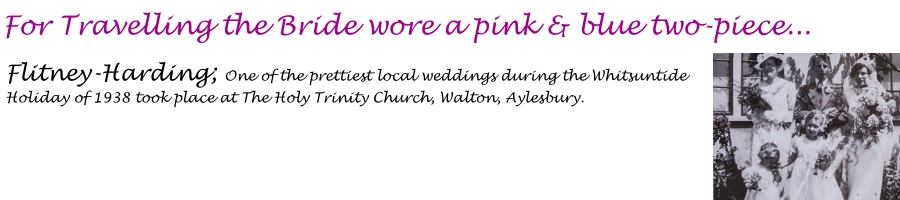
My mum Rene (Alice Irene Flitney née Harding) died in 1999. When my brother, sister and I went through her things we found an envelope full of old newspaper clippings and other bits and pieces. We looked through the papers and put the envelope away, but those yellowing pieces of paper keep whispering of half-forgotten times and places. Places like Butlers Cross, Stoke Mandeville, Aylesbury, West Wycombe, Little Kimble, Wendover, Ellesborough, Southcourt and Princes Risborough.

Thursday, 30 April 2015

All Change - A guest post by John Flitney

See previous post here


The last week of March 1958 were my final days of school in Bicester, thereafter I would have the whole of April free before entering the Royal Navy on the 6th of May that year. What I did during those weeks I do not recall now but I feel sure I would have spent a lot of time revisiting familiar places.

Strangely I cannot remember the exact details of my journey to Ipswich. I know Mum and Dad took me to the recruitment office in Reading where they signed consent forms to allow me to enlist in the Navy from that date and to agree to serve a further nine years from the age of eighteen. That done they returned home, with Mum crying for most of the journey. I along with a number of other recruits were taken to the station and then by train to Ipswich and from there by bus to the annexe of HMS Ganges at Shotley. My going to Ganges was another thing ‘fixed‘ by Major Withers, really I should have gone to HMS St.Vincent in Portsmouth but because I had an Aunt living in Ipswich the Major arranged, somehow, that I should go there. The new entry recruits, known as Nozzers, spent the first four weeks of training in the annexe before moving to the main establishment. During that time they were not normally allowed leave but on the second Sunday I was there Aunt Jean and Uncle Graham turned up at the main gate and asked if they could take me home for tea at their place. They agreed to be responsible for my return and so I was allowed out then and subsequent Sundays. I was most grateful for that as I was desperately homesick. This was the first time I had been away from home or family so tea on Sunday gave me something to look forward to.

 The film ‘Carry on Sergeant’ always reminds me of those first weeks of basic training, in many respects there were similarities. The kit issue was done almost exactly as depicted in the film. Going to the clothing store and getting a huge pile of garments, bedding and footwear. This all had to be marked with our names. For this we were issued a wooden stamp of our name and initials. This we used to apply our names either in black or white paint to our clothes and once it had dried embroidered over it with red thread. All this had to be folded correctly and stowed in our lockers in a certain way with the name showing. We were also taught how to wash ourselves and also our kit. For the latter we were given blocks of soap (Pusser’s Hard) and instruction on how to launder by hand. How to use an iron was another subject as we had to iron a lot of kit and put the correct creases in, like the seven horizontal ones in our bell bottom trousers. One amusing tale that went around at the time was of a conversation during a kit inspection. It was between the inspecting officer and a Nozzer of below average stature: - Officer “Well, and what do you think of the RN so far?” Nozzer, “It’s alright sir!” “Do you like your new uniform?” “It’s alright sir! “ “And what about your new underwear?” After a pause “It’s a bit tight under the arms sir!” We all had the same hair style too, it was known as the Shotley Look. Short back and sides and little on top. We also began to learn a new language, all the terms used in the navy that were different to civilian words, such as bulkhead for wall.

 Collingwood 44 Mess.   PO GI Smith.  Courtesy RA Fisk.    

After those first weeks of induction, learning naval law and discipline, kit upkeep and how to march to a reasonable standard we moved to the main establishment and became part of Collingwood division. The group I was with were in 44 mess, class1, and we would be together for the rest of our training. We were on the second floor of a two story block, each floor or mess had its own toilets, bathroom, laundry/drying room and ironing room. There were two classes per mess so twenty eight ratings to each. Our official rating at the time was Junior Seamen. This would be ‘home’ until mid 1959. Petty officers Durrant and Smith were our regular instructors, Smith for gunnery and parade drill, Durrant for seamanship and boatwork. Life became hectic from now on with hardly a moment of free time. Being able to swim, obviously, was essential. As I couldn't I was listed as a ‘Backward Swimmer”, (I couldn't swim either way, ahead or astern!) so I had to get up extra early and go for swimming lessons before breakfast. On arrival at the poolside on the first occasion I was told by the Physical Training Instructor to go to the deep end, walk to the end of the springboard and “Just jump in!” Such humour some of these military boys! I had never seen water this deep before, never mind got into any without my feet touching something, so I just stood there in fear. Not only of the waters depth but also of a potential bowel movement. After some graphic words of encouragement, which I chose to ignore the PTI took up a long pole and said “If it will make you feel better hang on to this!” Now me being an innocent country boy thought ‘how kind’. As soon as I gripped the end he heaved. By the time I hit the water I was at least ten feet up the pool with no sign of the pole. Eventually I passed the test of jumping in the deep end swimming two lengths of the pool and remaining afloat for ten minutes while wearing overalls. Another thing that was compulsory was three rounds in the boxing ring. I think it was to do with checking ones ability to take orders and possibly search for potential candidates for the Navy team. I was none too keen on boxing as I had never fared well against Richard at home. Just my luck the pairings for this particular match were done on physique only. If you were about the same build and height you were in the ring. I did the three rounds and like to think I hit my opponent a glancing blow at least once during those three long minutes. Turned out he had done very well in his local amateur boxing club before joining the navy.

Once a week, Saturday mornings, the main activity was cleaning the mess for “Rounds” which would start at noon. (Rounds = An inspection, by an officer, of all junior rates accommodation for cleanliness.) Any failure meant a ‘rescrub’ and forfeiture of any free time that afternoon. These inspections took place throughout the navy regularly and some years later I heard a story involving a ship commanded by Earl Mountbatten. He would carry out Captain’s Rounds and would have the cooks prepare an iced cake as a prize for the messdeck he deemed the best. The Royal Marine’s mess had been on a winning streak for some time. Mountbatten being a tad biased in favour of the seamen secretly, he thought, hid a penny in an awkward to reach small gap on top of the overhead fan trunking, thinking that if he found the coin again next time it would give him reason to find fault and award the prize elsewhere. To his surprise the following week he found two halfpennies in its place and on enquiring “What is this?” the Sergeant of the mess replied “None of the lads had put a penny up there so it was considered a potential ‘plant’ and therefore to avoid any doubts of theft and to prove we had cleaned the area we replaced it with coins to the same value sir!” Needless to say the marines won again and were also commended for their honesty.

Not long after moving to the main camp we were fallen in beside the mast. This stood at one corner of the parade ground, it had once been the foremast of HMS Cordelia. Now it stood a hundred and forty three feet (43.58m) high with a safety net rigged below it. We were ordered to climb up the ratlines to the upper yardarm, cross over and come down the other side. Just to check our head for heights I suppose. Thereafter we could go up any Saturday afternoon if we wished to.


As we got used to the routine and learnt the tricks of the trade we achieved things quicker and gained more free time in the evenings and at weekends. This allowed us to indulge in a choice of other activities. I teamed up with three others and went sailing on the river in either Cutters or Whalers which was great fun. Another thing I was involved in was the Field Gun competition. A scaled down version of the Earls Court spectacular of the Royal Tournament. Our event only involved changing wheels during the lap of the course with a much smaller gun and limber. Another memorable thing was my first experience of the ‘Grey Funnel Line’ at speed. We were taken for a days sea experience onboard a Daring class destroyer, HMS Dainty I think it was. When she was up to nearly thirty knots it was an impressive sight. Yet another thing I recall is euphoria. No! Not a feeling of pleasure, it was the navy version as in “ YOU FOUR ‘ERE!!” and was something to be dreaded as it usually resulted in some form of punishment such as having to run up and down Faith, Hope and Charity several times. They were the names given to a group of three long, steep flights of steps.

Toward the end of November I got Flu and had to spend some time in sickbay. Then I was put on the School List. This meant I could go back to the mess and attend classes but was excused marching and any strenuous activity. I had a chit from the MO to prove it. This was to last three weeks to allow for full recovery. Toward the end of it I was feeling fit and full of energy, and bored. So when the mess was one short for a football team I volunteered. BIG mistake as during the game I got a serious knee injury and was helped off the far side of the pitch. To add insult to it when the game finished I had been forgotten and everyone went off in the opposite direction back to the mess, ignoring my shouts for help. The sports fields were some distance from the main camp area so I got up and tried to hop but that only made the pain worse. It was about an hour later that three mess mates came looking for me and found me slowly crawling back to the mess. Now I was not only in pain but in trouble as well for disobeying medical orders. The worst punishment though was having to miss Christmas leave as I was sent to Chatham hospital for more specialised treatment and was there until January 1959.

The New Year brought more of the same routine, up early, breakfast, clean the mess then out to morning parade. From there we would march to wherever our morning tuition would be. Class 1 were all going to be Seamen/Gunners so we learnt all things to do with handling craft large and small. From anchoring or securing a ship to a buoy right up to how to rig for a jackstay transfer at sea. Plus all the lesser stuff like knots and splices or how to use ones peripheral vision when using binoculars at night. This was mixed in with days of weapons training on the 4inch mounting or the smaller twin barrel Bofors plus rifles and pistols and just like in the ‘Carry on’ film how to dismantle and clean then reassemble a Bren gun. There was also parade drill, being taught ever more complicated manoeuvres while marching, like those seen at the Trooping of the Colours ceremony. So never a dull moment. Easter leave came and went, all too quickly, at least I did get home then. We had to wear our uniform ashore in those days (ashore being anywhere outside the main gate) and I felt proud to do so.

                               Courtesy RA Fisk                               At home Easter leave

After the holiday we were into our last term at Ganges and took our final tests in the various categories. The most graphic and exciting was the simulation on the 4inch gun. This time we got the whole works, it was a supposed night attack so done in the dark, sprinklers in the roof created a heavy rain affect. Thunderflashes (very loud fireworks) represented enemy fire and large gouts of water came at us from each side. The gun used fixed ammunition, shell and cartridge together and we had to ram these into the breech as the gun tracked the target and avoid the same when it was ejected after being ‘fired’. All this while the deck was pitching and tossing vigorously. During these final weeks of training we got several inoculations, some of which caused discomfort for several days, these would prepare us for travels abroad.

Finally there was the Passing Out parade when Collingwood division would form the guard and march on parade with rifles with fixed bayonets to form up at the front of the parade for inspection by the Captain. Then, after a few speeches and awards, we led the whole establishment in our final march past and salute at HMS Ganges.

Photographs courtesy RA Fisk


To be continued...

RA Fisk was the official photographer at Ganges, and those pixs marked courtesy of Ra Fisk were purchased from him direct by me in 1958/9.

Wednesday, 22 April 2015

Memories from an envelope

I was already putting this post together when I noticed this week's Sepia Saturday prompt - Aha thought I – two birds with one stone!  The two birds in question are my sister Sue and I (forgive the pun). There are no babies in the post even though we have five between us, but I hope two weddings will make up for that. The post contains an open letter to my sister; please feel free to read it. I have no secrets from you!


My mum (Rene Flitney) kept an envelope full of newspaper clippings, greetings cards and other bits and pieces. This is the second in a series of posts about items from that envelope. If you wish, you can read the first part here.   

It was no surprise to find a newspaper cutting from our wedding tucked inside the envelope, but we were surprised to find a wedding invitation. Those invites meant a lot to us back in 1970, but we didn't think to put one in our keepsake box. 

Terry and I agonised over the choice of design for weeks. Actually, I don't think Terry could have cared less, but he did his best to pretend he did!  In the end, we settled on a 'stained-glass window' effect. 


I have no idea why we chose the ones with a green background as our wedding was all white and pink! Perhaps colour themed weddings weren't so important then.

A Honeymoon in Austria 

A honeymoon in Austria and Switzerland followed the wedding at Odiham Parish Church of Miss Barbara Ann (Tut! my name is Anne) Flitney, daughter of Mr. and Mrs. D. W. Flitney, of Well Manor Farm, Long Sutton, and Mr. Terence Fisher, son of Mr. and Mrs. F. Fisher, of Blunden close, Basingstoke. The service was conducted by Rev. Philip Tidmarsh. 

Given away by her father, the bride wore a full-length dress of white nylon voile. It was high necked and the neck, bodice and cuffs were trimmed with pink lace. Her shoulder length veil was held in place by a band of white roses and she carried a bouquet of white lilies of the valley and pink rosebuds.

Attendants were the bride's sister Mrs. Susan Wood (Matron of Honour), and bride's nieces Paula Wood and Michelle Flitney. Mrs Wood wore a full length, pink dress with bell sleeves, trimmed with rosebuds. She wore a pink rose in her hair and carried a bouquet of pink and white carnations. Paula and Michelle also wore full length, pink dresses with long sleeves trimmed with white lace. They wore bands of tiny pink rosebuds and carried pink rosebuds and white stephanotis.
~~~

This is probably a good time to offer an apology to my sister!  Sue had no desire to be called a ‘matron of honour’ and even less desire to be dressed head to toe in pink!  She favoured a pretty green dress, thinking it would be better suited to her age and marital status. But I stamped and fumed and insisted on the pink.  Sorry Sue. Mind you, I still think you looked lovely in pink!


Our wedding day the 27th June, 1970. All Saints Parish Church, Odiham.
My sister Sue looking pretty in pink.  Me trying not to look at the camera! Terry on my left, David Jones (best man) on the right and Sue's daughter Paula in front. 


My brother Tony is holding the second little bridesmaid (right of picture third row back). Michelle hated the camera and refused to have her picture taken. 


3rd June, 1961 this time I'm the bridesmaid and my sister is the bride.  
From the left; Mr. & Mrs Wood, Mike Wood, Bob Wood (the groom), Sue, me, mum, dad and Marion in front.

Dear Sue, I was so excited when you asked me to be your bridesmaid. I loved my lilac dress, white gloves, socks and sandals.  I felt like a princess but looking back at the photos I can see I didn't look remotely like one. The little bridesmaid, on the other hand, looked adorable.

Did you know mum made me wear the entire ensemble, including the socks, to the end of year school party? Loud laughter and shouts of “she’s come as a bridesmaid” greeted my arrival. I was thirteen – can you imagine my shame? I spent the entire evening hiding in the loo, while my friends paraded around in mini skirts and white high-heeled boots!

So I guess that makes us even?

This is my contribution to Sepia Saturday 276: The Newlyweds and their baby

See who else is getting wed at  Sepia Saturday


Tuesday, 7 April 2015

Guest Post - My Sister Remembers - Part Nine

A guest post by my sister Sue Poulter. See previous post here

Part of the deal at Wyck was that I had to work on the farm. One of my first jobs was helping the other women cut strings to use for training the hops. It was winter time and very cold, so I always put a hot-water bottle in the pram with Jackie, but it was hard to keep her warm and impossible to keep myself warm. When the snow came I asked the farm manager if we could have some heating in the barn, but his answer was a resounding no. The snow was so bad I had to pull the pram through snowdrifts to get to the barn. All the other women seemed happy to put up with it, but I downed tools one particularly bad day and said, “No heat, no work” and walked out. The other women chased after me and said that Bob would lose his job, but I won the day, and we had a heater installed in the barn soon after. It didn't make much difference though and the snow lasted until after Easter.

Sue and Jackie at Wyck

Once Bob started working in the hop gardens all his clothes and the house smelt of hops which I hated.  Following harassment from the farm manager, who thought I was ungrateful and should remember I was living in a tied cottage, Bob decided it was time to look for another job.  Mum and dad felt sorry for us, and dad asked Bob if he would like to become his Herdsman at Well Manor Farm.  We thought this would be fine, but it doesn't pay to live next door to your parents and certainly not to work for your father-in-law. Dad was not the easiest of people to work with and didn't have much patience with Bob. The hours were long, and the pay was poor and Bob ended up getting part time gardening work on his one day off a week. The house we lived in was very cold, and we only had a fire with a back boiler for heating the water, and coal was so expensive we had to sell some of our belongings to pay for it.  I loved the garden though and grew all our own vegetables. I remember a visit from granny who seeing me digging up potatoes gave Bob a really hard time, but he was working all hours and was always exhausted.

Bob and Jackie in the garden at Well

Mum and dad seemed to be fairly comfortably off at this time so when the grocery van came from Bentley Stores mum would buy loads of vegetables, fruit and "best ham" whilst Bob and I could only afford perhaps a loaf of bread. Funny when a mother seems to take delight in having more than her children.  I remember on one occasion she bought a new rug for the kitchen and asked if I wanted the old one. I was really pleased as we didn't have one, but when she brought it round she asked me to pay for it. I paid up but could have done with the money to put towards the outstanding electricity and other bills.

The Well at Well

The village had not changed since I was a teenager. There was an old water well in the middle, which I assume gave the place its name, and one pub called The Chequers, there were no buses and because Bob didn't drink there was nothing to do in the village. Jackie was a very bright baby. She read simple words and remembered every song and nursery rhyme we taught her, and of course I had plenty of time to spend with her. The highlight of my year was to go next door to watch the Royal Variety Performance on mum and dad’s television. I would wash, change and put my make-up on, as though I was going somewhere special. I started driving lessons as Bob thought it would be good for me to get out and about. The lessons had to stop when I found I was pregnant again and there was no chance of any spare money. This time the doctor kept more of an eye on me because of the problems when I was pregnant with Jackie. We couldn't afford all the food he suggested, but we had plenty of fresh vegetables and salad in the garden, so I lived on that. Probably the reason I regained my figure so quickly after the new baby was born.

Mum in the garden with Michael

Michael was born in the February of 1964 and Mum Wood looked after Jackie while I was in the hospital. His was a more straightforward birth, and he was a lovely placid baby with a mop of black hair. Everyone said he looked like a member of The Beatles, who were all the rage at the time. I was in the hospital for ten days and really looking forward to getting home to Jackie but when I did she had forgotten me and bonded with Mum Wood.  It was really upsetting but it only took a few days for her to get used to me again. Thank goodness Michael was such a good baby as not long after he was born Jackie suddenly became ill. She was two years old that summer, and it was then that she started screaming at night while rocking backwards and forwards and hitting her head against the wall. It was very distressing and nothing we did helped. The doctor suggested giving her junior aspirin, which also didn't help but she seemed better after a week or two and so with much relief we put it down to a virus. 

We managed to scrape up enough money for me to start my driving lessons again, and luckily I passed the test at my first attempt. We didn't know it at the time, but this was to prove a Godsend. 

It was a short while later that Bob began to have health problems. During the war, when he was six or seven, he was run over by a tank at the top of Worldham Hill (probably playing “chicken”or some such game) and spent many months in hospitals undergoing plastic surgery to his arm. Now all these years later a growth appeared on his arm. The doctor decided the growth would have to be removed and although the operation was a success, it made us appreciate each other more and reminded us just how short life can be. Bob always wore long-sleeved shirts even in the summer months but after more plastic surgery, he was happy to have his arm on show.  Jackie had continued to be a concern and on one of the doctor's visits to Bob, I asked him to take a look at her.  She had put on a lot of weight, and her face was often flushed. I thought it might be indigestion, but the doctor felt it could be epilepsy. My dad said it would be best to forget about it as she would be fine when she got older. Not an easy thing to do when you are worried about so many things.

Michael

I found out I was pregnant again when Michael was eight months old. I must say I wasn't very pleased as I felt two children were enough. Bob, however, was over the moon saying he would get his football team yet! As I've said previously Michael was a lovely baby, very easy to feed and always happy to sleep. He was baptised at Long Sutton Church on a very warm day when I was already seven months pregnant. After the service, all the family and friends came back to our house for tea. It was a nice day, but I was quite pleased when everyone went home.  When I went into labour with James Matthew in July 1965, Jacqueline and Michael went to stay with their Auntie Pat and Uncle Mike in Alton, where they had a lovely time playing with their cousins. I think coming home to a crying baby must have been a bit of a shock for them. Although they had a lovely time in Alton it was a shame they could not stay at home with Grandma and Granddad Flitney living next door, but they made it quite clear that as I was having the children it was my responsibility to find someone to look after them as they were not going to!

Sue holding Michael and mum holding hands with Jackie

Not long after James was born Bob started getting attention from a very attractive young lady in the village. Her car always (conveniently for her) broke down outside our house when Bob was at home for lunch. He would leave his lunch and go out to check she and her car were all right. After a few months of this I went to see her and told her just what I would do if she didn't leave him alone.  I can be quite a scary person when angry, and she backed off. I felt almost sorry for Bob as I’m sure he was quite innocent as to what she was up to, but I was having none of it.  Soon after this he decided it was time for a move, especially as relations between him and dad were becoming very strained.

After a few interviews he secured a job at Taplins Farm, between Hartley Wintney and Winchfield. The farm has now gone the way of many others and is an Industrial Estate. But when we lived there it was a rural area with beautiful views. We had a detached house with a conservatory on the side, and a lovely playroom for the children. When we first moved in the children had some bad tummy upsets and Michael often had sore throats and had to have his tonsils removed. Jackie also became unwell again and began to have “vacant” spells. The doctor suggested we take her to see a paediatrician in Reading. Bob couldn't get time off for the appointment so I drove myself and Jackie there. The consultant was most unsympathetic and after carrying out some tests said, “Well you know Jacqueline was starved of oxygen at birth and is brain damaged, which has resulted in Epilepsy." He started her on a course of anticonvulsant drugs and told me to come back in three months.  I was absolutely astounded, as although we had both had a bad time during her birth, not one person had mentioned her being starved of oxygen. The consultant assumed I knew all about it, but things were so very different in those days, and the patient was seldom told the complete story.  Now it was up to me to drive home from Reading and break the news to Bob...


To be continued 


Thursday, 26 March 2015

Farming at Ibstone, Buckinghamshire and Thame, Oxfordshire in the 1940s and 50s

This week’s Sepia Saturday prompt sent me rushing for the family albums. My dad and brother were both farm workers, and much of my childhood was spent riding around on tractors. I don’t claim to know anything about these machines because I was only about four when the photographs were taken. My brother Tony is ten years older than me, and I'm guessing he was about fourteen in the first picture.  

My brother hard at work on a Fordson Major tractor.


Me Barbara Fisher (nee Flitney) when we lived in Ibstone.


My dad is driving this odd-looking caterpillar/tractor type thing. I'm not sure who is on the Combine Harvester. It might be dad’s brother Owen (Flitney) or a German Prisoner of war.  My brother and sister both remember the POWs, who worked on the farm. I have only vague recollections of the stories my parents used to tell. I know they became particularly close to one of the prisoners and talked about him all the time, but sadly I can’t remember his name.

Even before the German surrender some of the POWs were put to work as agricultural labourers. After VE-Day, all prisoners were required to work. Most POWs were employed on farms, as Britain urgently needed a high level of food production, and there was a shortage of agricultural workers.

At first, it was usual for groups of about thirty men to be escorted by armed guards to the fields where they were to work. They were kept under close supervision at all times. However, following the German surrender, the British government allowed some prisoners to be billeted on the farms where they were employed under minimal supervision. Typically, one to four POWs would live at each farm, often taking their meals with the farmer and his family. In this way, close bonds were forged between the farmers and the German prisoners. Source Wikipedia 

Update December 2017 – the caterpillar is a Fowler FD3, and the harvester is a Grain Marshall 568 Combined Harvester. With thanks to my brother Tony Flitney. 

We were living on a farm at Ibstone in Buckinghamshire when the photographs were taken. My sister and I have vivid memories of trees being cut down in the woods around us.  The noise of tractors and heavy chains is something you don’t forget.  I looked online to see if I could find out what this machine is called and stumbled across several pictures of antique logging tractors that look very similar so maybe this is the one used for the logging. [Update December 2017 – my brother confirms this was the caterpillar used for logging and the trees being felled were large beech trees, which were taken to High Wycombe for use in the furniture trade. There is an interesting article about furniture making in Wycombe here]


The photographs of the Claas Combined Harvester that follow were taken on a farm near Thame in Oxfordshire, my dad is driving the tractor, and my brother Tony is up top. 


Fast forward thirty plus years and my brother is still hard at work.


In the first of these two photographs, he’s showing Sarah, Duchess of York the controls. The second picture shows Prince Andrew and Sarah standing with the digger.  These were taken during the very early stages of the building of Sunninghill Park in Berkshire destined to be the new home of the (then) happy couple.  


Fast forward another thirty years, my brother is retired. Andrew and Sarah are divorced, and I'm sharing photographs with friends from around the world, how times have changed. Now it’s time for you to plough a straight furrow over to Sepia Saturday to see what my fellow Sepians are reminiscing about.

This is my contribution to Sepia Saturday 272 : Tractors / Agriculture / Wheels


Wednesday, 18 March 2015

Eli and Ellen Flitney

See previous post here

My great grandparents Eli and Ellen Flitney had eight sons born between 1876 and 1898. When the first of their sons was born the family were living at Chalkshire a hamlet in the parish of Ellesborough in Buckinghamshire. Later, they moved to Hill End, Ellesborough, and it was there that Ellen continued to live after the death of Eli in 1899.


Hill End

Ellesborough lies on the northern slope of the Chiltern Hills, with the highest point being Combe Hill, at 852 ft. The Upper Icknield Way wanders from the main road, running from Little Kimble Church to Wendover, through Ellesborough village and the hamlet of Butlers Cross... (Read more at British History Online.)  At the time of the First World War, the principal occupation of the male inhabitants was almost entirely agricultural, while the women were more likely to be lace makers or in domestic service. By 1911, six of Ellen’s eight sons would be working on the land. Of the other two sons, Leonard was a rural postman and Fred at the age of thirteen was a telegraph messenger.

Hard work was a way of life for many families at the beginning of the 20th century. Wages were low and working hours long. Away from work family life often revolved around the church, with its choir and Sunday school. In Ellesborough and surrounding villages the big event of the year was the Annual Flower Show organised by the Velvet Lawn Cottage Garden Association. A varied programme of events was on offer each year and in 1912 the main attraction was an Old World Fair with swing boats a coconut shy and a variety of stalls. The inclement weather didn't diminish the fun, and much merriment accompanied the contestants in the spar boxing competition as they attempted to spar while sitting astride a damp pole raised some way from the ground. Elsewhere in the show Mr. T Walker of Thame was responsible for judging the horticultural section. He awarded Mrs. Flitney a first prize for her display of geraniums. The report in the local paper doesn't include a Christian name, so I don't know if this was Ellen or another member of the family.

In 1913 the Ellesborough Brass Band, the Athletics and the ‘bowling for a pig game’ presented by Sir Lancelot Aubrey Fletcher with prizes awarded by Lady Fletcher were the most keenly attended attractions.  Mrs. Flitney again won a prize but this time it was for needlework.

Ellesborough Brass Band (year unknown) 

In 1914 war intervened and the show was abandoned; 


The assassination of the Archduke Franz Ferdinand and his wife on the 28th June 1914 set off a chain of events that would change the lives of millions of ordinary people.  Austria-Hungary (supported by Germany) declared war on Serbia on the 28th July. This was followed by Germany declaring war on Russia and France. On the 4th August, German troops marched on France, taking a route through Belgium. Britain had agreed to guarantee Belgium’s neutrality, and immediately declared war on Germany and life would never be the same. 


Many of the menfolk of the village volunteered for active service and when conscription began in January 1916 more would follow.  

A recruiting depot August, 1914.
By August 1917, three of Ellen's sons, Sidney, Abel and Arthur would be dead and all but one of her other five sons would be serving their country.

To be continued...

Source documents;
The Bucks Herald
http://www.visionofbritain.org.uk/
Census returns
http://www.british-history.ac.uk/


Monday, 9 March 2015

Last Days of Childhood at Murcott a guest post by John Flitney

See previous post here

 Bramwell H. Withers OBE

Major Withers was born in Australia on 4th October1888 and came to England with his parents while still a young child. By 1908 he was a lieutenant in the Loyal Regiment (North Lancashire) and would later become a founder member of part of the Boy Scout movement. I had known him for fourteen years prior to his death but had little knowledge of his past until Mum sent me a cutting she had taken from the obituaries page of the local paper in 1968. ( Also, latterly, by research on the internet) He had seen active service with the Loyal Regiment during the First World War in Palestine and East Africa. He then spent ten years with the Egyptian army in the 11th Sudanese, and the Western Arab Camel Corps. By 1929 he was in India having rejoined his regiment. There he met and later married Lillian Bibby. They had no children. On retiring from the army he spent almost three decades working with boys clubs and the Scouts in Lancashire. He became a magistrate and in that capacity took a great interest in juvenile cases, endeavouring to find the best way to help youngsters to start afresh. In 1908 he started one of the earliest Scout troops in Winchester and held an interest in Scouting all his life. Often there would be lads camping in his garden, these would mostly come from a London Welfare Department as needing help. Among other things he was involved with the Bridewell Trust which maintained a charitable school in London, he was a governor of Bicester school and for ten years represented Murcott on Ploughley rural district council. Major Withers died, aged eighty, peacefully at home, after a period of illness. 

My last visit to Murcott House, saw him confined to a bed in the lounge with his sister Thelma in attendance. (Mrs Withers had deceased some years earlier.) He was heavily sedated but even so seemed pleased to see me. We chatted for a short time until he drifted into sleep again. I sat with him for a while before quietly leaving. The funeral was held at Charlton-on-Ottmoor church and I would like to quote one thing the Rector, the Reverend E.H.W. Crusha, said about him at the time, “ In thirty years of soldiering and thirty years of youth work there are many who are better men for knowing him!” I am proud to say I am one of those, remembering him with affection and I am honoured to have known such a remarkable person.
~~~~~~~~~~~~~~~~~~~~~~~~~~~~~


Major Withers in Africa


Most likely it was the Saturday morning following our first meeting with Major Withers that Richard and I first called at his house. He greeted us warmly and invited us in, straightaway asking if we had come to help with the trophies. There were all manner of things from his military past, regimental photos and regalia, swords, Kukris and African shields and spears to name but a few. We spent a couple of hours placing some of these things for display in the hallway before going to the kitchen for some tea and biscuits. Here the Major asked if we would like to come on a regular basis and do some odd jobs for him and perhaps pursue whatever hobbies we might have. He had a large workshop that was at our disposal and we were welcome to bring along any other boys from the village who might be interested. Thus started a long and happy association with the Major. I think Mum and Dad were happy too as it gave us somewhere to go as there was nothing else locally to entertain us.

Until leaving school we would spend a lot of time at Murcott House. Roy, the other lad in the village, would come along sometimes and there were occasionally boys from other parts of the country. We would do odd jobs around the house and in the garden, or if the weather was bad there were things to occupy us in the workshop. One of the first things the Major had us do was rig a trapeze swing in the largest apple tree in the garden. This would become a regular source of amusement and exercise. Mowing the lawn was a contested job too as the petrol driven machine towed a seated roller and was a first lesson in driving. We were also taught how to use a gun safely and had competitions at target practise at which Richard excelled.


                        Take off for Richard                     Back Row L to R; Richard, Major Withers, Roy
                                                                                     Front row L to R;  London lad?  me

Trying my hand at target practice 

On leaving college Richard enlisted in the RAF in 1956 and by then Roy was at work, I think in Oxford, so for two years I was on my own so to speak. I missed Richard’s company and during that time I became a bit of an introvert, content with my own company and thoughts. It was something that would affect me for many years to come. I had made no friends at school and there were no other boys nearby, therefore the Major’s would become a focus for my spare time. He had quite a large rose garden and having expressed a liking for them he encouraged me to grow some at home by actually providing a variety of plants. They did reasonably well and I would later pick some of the best blooms to try and entice Audrey out for a walk. They didn't help, and besides she was always about to wash her hair no matter what time I called?? Didn't do my confidence any good at all, girls were supposed to like being given flowers. I didn't spend all my time at Murcott House as there were things at home to do, school homework was the boring bit and came first during term time. Then there were my roses to check and other jobs for Dad in the vegetable garden and the grass needed cutting regularly. Also I would milk the cow after school if Mum was busy, plus collect the eggs from the few chickens we kept.

For all the time we lived at Murcott the toilet was a bucket affair in a small shed in the garden. I had grown enough by now to be able to cope with the job of emptying the bucket when required. This entailed carrying it carefully to the hole previously dug at the furthest part of the garden, tipping it in, whilst holding my breath, then covering the deposit with earth from the windward side. About every six weeks or so a new hole had to be dug so I would do that too, making a hole 4ft ish square and 5ft ish deep. Also, if Dad had felled a tree, I would hand saw, then with an axe or sledge hammer and steel wedges, split logs for the fire. I had a lucky escape one time while trying to split a long section of green Elm. It was a particularly tough piece and I had not reached half way along it before having three wedges jammed in it. That left one more wedge, the widest and rarely needed. So I started that one and got it stuck too. In my frustration I gave it an almighty bash with the hammer and to my surprise it disappeared. As the log hadn't split I bent over to see what had happened when the wedge disappeared again, into the soil right alongside me. The tension in the timber had fired the heavy metal high into the air. Learning from my mistake I used the wider wedge in the already parted section to free the others and reused those to finish the job. To ‘get away from it all’ I would take our dog, Trixie, for long walks down on Ottmoor.

Young Trixie                                                        Older Trixie 

I suppose it was around the time of my fourteenth birthday that I began to think of what I would do on leaving school. While Richard had built model aircraft I had done Airfix kits of naval ships. He had gone into the RAF...logical! Perhaps I could try the Navy, there was nothing locally that enticed me. With Mum and Dad’s encouragement and the Major’s help I made that my objective. (Dad had been turned down, on medical grounds, for military service. He had desperately wanted to avenge the death of his father during the Great War. So when I wanted to join my brother in the services he was not displeased. During my final year at school I made more of an effort and with some extra private evening classes, financed by Major Withers, I improved. Late in 1957 I sat the entrance exam for the Royal Navy. Not in a recruitment office as you might think, the staff from the Reading office came to Murcott and I took the test, one afternoon, sitting at a bench in the Major’s workshop. On completion of the test the Major suggested that I go home, and if Mum approved, I should return later and have dinner with them all. On my way out I noticed the dining table laid ready for the meal and couldn't understand why each place had so much cutlery. Mum said, “I should attend the dinner and not to worry about the cutlery!” Adding, “It will probably be a three coarse meal and to use the cutlery from the outside first. Just watch the others, wait for them to start and mind your manners!” So later that evening I nervously sat down to dine with a Royal Navy Commander, a Lieutenant, a Sergeant Royal Marine and a Petty officer all in uniform with the Major presiding at head of table. (A bit different to tea at home but there was nothing better than Mum’s cooking.)

Some weeks later I went for the medical examination and then it was a case of waiting for the results of both tests. One morning a letter came for me and I excitedly opened it only to read that I had to have another medical, this time in London. Dad couldn't get time off work and Mum did not fancy the trip so they asked the Major if he would accompany me. Fortunately the date would coincided with a business trip he had planned so he was happy to oblige. It turned out that when, at the first medical, being asked about any serious illness I had had as child I, being in a rather nervous and confused state at the time, had replied “Asthma!” A serious error as that would, if true have ruled out any hope of joining up. What I had been trying to remember was Eczema as I had been seriously afflicted with that as a baby. Anyway after a thorough chest examination it was back to the waiting game.

Easter in 1958 was in April so I would finish school at the end of March when the school broke up for the holidays. The long awaited letter, along with some consent forms for Mum and Dad to sign, came during my last week at school..................

To be continued............


Related Posts Plugin for WordPress, Blogger...